
Best Garmin Fishfinders: 7 Picks From Striker, Vivid, and ECHOMAP
Seven Garmin fishfinders compared across the Striker Plus, Striker Vivid, ECHOMAP UHD2, and Striker Cast lines, with Garmin specs and who should skip each.
 Updated November 1, 2026
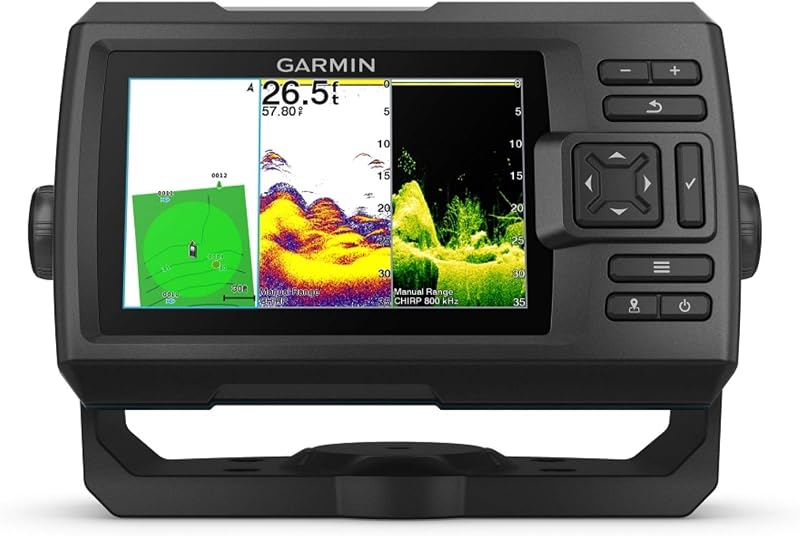
The best Garmin fishfinders for most anglers pair CHIRP traditional sonar with ClearVü scanning sonar and built-in GPS, and the right one depends on where you fish. For straightforward ClearVü and GPS on a boat, start with the Striker Vivid 5cv or 7cv; for preloaded charts, an ECHOMAP UHD2; for side imaging, the ECHOMAP UHD2 73sv; for hard water, the Striker Plus 4 Ice Fishing Bundle; and with no boat at all, the Striker Cast.
Garmin’s lines look alike on Amazon, so we compared seven Garmin packages across the Striker Plus, Striker Vivid, ECHOMAP UHD2, and Striker Cast lines, using Garmin’s own spec pages for every one.
This guide is general product information, not repair or electrical safety advice. Follow the installation, wiring, and charging instructions in your product’s manual, stop using any battery, charger, or electronics that overheat, swell, or smell of burning, and contact the manufacturer.
Our Top Picks at a Glance
- Lightest Pick With ClearVü: Garmin Striker Vivid 5cv. 1.0 lb per Garmin, against 1.1 lb or more for every other ClearVü unit here, with a 5 in, 800 x 480 pixel screen.
- Largest Striker Screen, With Wi-Fi: Garmin Striker Vivid 7cv. A 7 in display against 5 in or less on the other Striker screens here, and the only Striker here with Wi-Fi, per Garmin.
- Only Pick With SideVü and a Touchscreen: Garmin ECHOMAP UHD2 73sv. Garmin lists SideVü and a touchscreen for this unit and for no other unit here.
- Preloaded Inland Maps on a 5 in Screen: Garmin ECHOMAP UHD2 53cv. U.S. inland charts like the 73sv, on a 5 in screen instead of 7 in.
- Preloaded Coastal and Great Lakes Charts: Garmin ECHOMAP UHD2 54cv. The only unit here with Navionics+ U.S. coastal and Great Lakes mapping, per Garmin.
- Ice Kit With Transducer, Float, and Battery: Garmin Striker Plus 4 Ice Fishing Bundle. The only package here with an ice transducer, float, battery, charger, and carrying bag in the box, per Garmin.
- Castable Sonar, Uses Your Phone as the Screen: Garmin Striker Cast. A 2.6 oz (75 g) float per Garmin, with no mounting; it streams sonar to your phone or tablet.
Garmin Fishfinders Compared
G = Garmin’s U.S. page or manual. Scroll sideways on a phone to see every column.
| Model | Screen | Sonar with included transducer | Maps | Power | Weight |
|---|---|---|---|---|---|
| Striker Vivid 5cv | 5.0 in (about 2.6 x 4.3 in), 800 x 480 pixels (G) | CHIRP traditional and ClearVü, GT20-TM (G) | Quickdraw Contours; no preloaded charts listed (G) | 12 to 20 V DC (G) | 1.0 lb (G) |
| Striker Vivid 7cv | 7.0 in, 800 x 480 pixels (G) | CHIRP traditional and ClearVü, GT20-TM (G) | Quickdraw Contours; no preloaded charts listed (G) | 12 to 20 V DC (G) | 1.7 lb (G) |
| ECHOMAP UHD2 73sv | 7.0 in (about 6.1 x 3.4 in) touchscreen, 800 x 480 pixels (G) | CHIRP traditional, ClearVü, and SideVü, GT54UHD-TM (G) | Garmin Navionics+ U.S. inland (G) | 9 to 18 V DC (G) | 2.2 lb (G) |
| ECHOMAP UHD2 53cv | 5 in (about 4.3 x 2.6 in), 800 x 480 pixels (G) | CHIRP traditional and ClearVü, GT20-TM (G) | Garmin Navionics+ U.S. inland (G) | 9 to 18 V DC (G) | 1.1 lb (G) |
| ECHOMAP UHD2 54cv | 5 in (about 4.3 x 2.6 in), 800 x 480 pixels (G) | CHIRP traditional and ClearVü, GT20-TM (G) | Garmin Navionics+ U.S. coastal and Great Lakes (G) | 9 to 18 V DC (G) | 1.1 lb (G) |
| Striker Plus 4 Ice Fishing Bundle | 4.3 in color (G overview), 272 x 480 pixels (G) | CHIRP traditional, Dual Beam-IF ice transducer (G) | Quickdraw Contours (G) | 7 Ah sealed lead-acid battery in the kit (G) | 0.7 lb (G) |
| Striker Cast | Your phone or tablet | 2-D sonar at 260 and 455 kHz, ice flasher mode (G) | No GPS; downloads Quickdraw Community maps (G) | Internal battery, 10 hr typical (G) | 2.6 oz (G) |
How We Chose
We started with Garmin fish finders sold new on Amazon in the U.S., read each full listing, and opened Garmin’s U.S. page for every model; all seven appear there as current products. Four listings had owner reviews we could read.
We did not name a Best Overall in this roundup. The units here that meet our Best Overall criteria already hold that title in other roundups, and we give a model the title in one roundup only; the rest fall short of our Best Overall threshold under our published method. Each pick instead carries a label backed by a spec you can compare in the table. The order is editorial: boat-mounted ClearVü units first, the Striker Vivid models from smallest screen to largest, then the ECHOMAP UHD2 models with the side imaging 73sv ahead of the inland 53cv and coastal 54cv, and last the two special-purpose kits, the ice bundle and the castable Striker Cast.
Amazon owner ratings form the base of each AnglerTechLab Score, with a limited editorial adjustment explained on our How We Review page; we do not run our own product trials. Two scores here are 0.2 lower: the Striker Cast listing names an LCD display for a sonar that uses your phone as its screen, and the ECHOMAP UHD2 73sv listing shares its ratings with the 6 in 63sv and lists a deeper maximum depth than Garmin gives for the included transducer. Other brands are compared in our roundup of the best fish finders and our fish finders section.
We earn a commission from qualifying purchases made through links on this page. Commissions never affect our rankings or AnglerTechLab Scores.
The order of these products is explained in the article. The AnglerTechLab Score starts from Amazon customer ratings, with a limited editorial adjustment explained on our How We Review page.
| Award | Product | AnglerTechLab Score About AnglerTechLab ScoreThe AnglerTechLab Score is calculated with the published method on our How We Review page. Learn more › | |
|---|---|---|---|
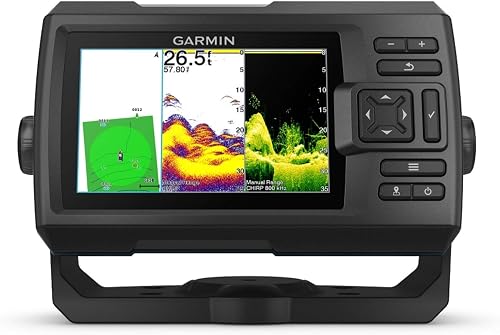 Garmin Striker Vivid 5cv with GT20-TM Transducer |
8.6/10 | Buy | |
 Garmin Striker Vivid 7cv with GT20-TM Transducer |
8.6/10 | Buy | |
 Garmin ECHOMAP UHD2 73sv Chartplotter |
8.9/10 | Buy | |
 Garmin ECHOMAP UHD2 53cv with GT20-TM and U.S. Inland Maps |
8.6/10 | Buy | |
 Garmin ECHOMAP UHD2 54cv with GT20-TM and U.S. Coastal Maps |
8.4/10 | Buy | |
 Garmin Striker Plus 4 Ice Fishing Bundle |
8.9/10 | Buy | |
 Garmin Striker Cast Castable Sonar |
8.4/10 | Buy |
Garmin Striker Vivid 5cv with GT20-TM Transducer
A 5 in GPS fish finder with traditional CHIRP and CHIRP ClearVü scanning sonar, sold with the GT20-TM transducer. Garmin lists an 800 x 480 pixel display, 500 W (RMS) transmit power, and Quickdraw Contours for building your own 1 ft contour maps. Garmin lists no preloaded charts.
Pros
- 800 x 480 pixel 5 in display, per Garmin
- Included GT20-TM transducer runs traditional CHIRP and ClearVü
- Quickdraw Contours records your own 1 ft contour maps
- 5,000 waypoints and 100 routes on Garmin's spec page
Cons
- No preloaded charts, per Garmin
- No SideVü or Wi-Fi listed for this model
- Needs a 12 V source; the series manual says it will not turn on below 12 V DC
Garmin Striker Vivid 7cv with GT20-TM Transducer
A 7 in GPS fishfinder with CHIRP traditional and ClearVü scanning sonar. Garmin lists 800 x 480 pixels, Quickdraw Contours mapping with 1 ft contours, and Wi-Fi for the ActiveCaptain app; the included GT20-TM transducer runs both sonars. Garmin lists no preloaded charts.
Pros
- 7 in screen at 800 x 480 pixels, per Garmin
- GT20-TM transducer runs traditional and ClearVü sonar
- Quickdraw Contours records your own 1 ft contour maps
- Wi-Fi for waypoint transfer and Quickdraw Community data, per Garmin
Cons
- No preloaded charts listed
- Garmin lists no SideVü for this model
- Needs a 12 to 20 V DC supply, per Garmin
Garmin ECHOMAP UHD2 73sv Chartplotter
A 7 in touchscreen chartplotter with keyed assist and preloaded Garmin Navionics+ U.S. inland mapping. Garmin lists traditional CHIRP, ClearVü, and SideVü sonar support, multi-band GPS, and Wi-Fi links to the ActiveCaptain app and compatible Force trolling motors; the listing names a GT54 transducer in the package.
Pros
- Traditional, ClearVü, and SideVü sonar support, per Garmin
- Preloaded Navionics+ U.S. inland mapping
- Multi-band GPS with a 10 Hz receiver, per Garmin
- Wireless control of compatible Force trolling motors
Cons
- No memory card in the box; ActiveCaptain setup and Quickdraw recording need one, per the manual
- The included transducer lists 800 ft for traditional sonar, short of the listing's 1,000 ft
- Needs a 9 to 18 V power source, per Garmin
Garmin ECHOMAP UHD2 53cv with GT20-TM and U.S. Inland Maps
A 5 in chartplotter and fishfinder with CHIRP traditional and ClearVü scanning sonar. Garmin lists 800 x 480 pixels, preloaded Garmin Navionics+ U.S. inland mapping, a microSD card slot, Wi-Fi, and a GT20-TM transducer in the box.
Pros
- Preloaded U.S. inland lake maps, per Garmin
- microSD card slot for cards up to 32 GB
- Accepts 9 to 18 V DC input, per Garmin
- Wi-Fi for the ActiveCaptain app
Cons
- Smaller screen than the 7 in Striker models
- Coastal charts come on the 54cv instead
- No SideVü with the included transducer
Garmin ECHOMAP UHD2 54cv with GT20-TM and U.S. Coastal Maps
A 5 in chartplotter and fishfinder with CHIRP traditional and ClearVü scanning sonar. Garmin lists 800 x 480 pixels, preloaded Garmin Navionics+ U.S. coastal and Great Lakes mapping, tide tables, a microSD card slot, Wi-Fi, and a GT20-TM transducer in the box.
Pros
- Preloaded U.S. coastal and Great Lakes charts, per Garmin
- Wi-Fi for the ActiveCaptain app
- microSD card slot for cards up to 32 GB
- Accepts 9 to 18 V DC input, per Garmin
Cons
- Charts cover U.S. waters; one owner could not get charts for the Bahamas
- One owner found the menus not entirely intuitive
- No SideVü with the included transducer
Garmin Striker Plus 4 Ice Fishing Bundle
A portable ice kit built around the Striker Plus 4 fishfinder. Garmin lists a 4.3 in color display with built-in GPS, a Dual Beam-IF ice transducer (CHIRP 77 and 200 kHz), and a carrying bag with foam float, rechargeable battery, and charger; the Striker Plus manual describes a flasher page.
Pros
- Ice transducer, float, battery, charger, and bag in one box, per Garmin
- Two beam widths, 45 and 15 degrees, per Garmin's install guide
- GPS waypoints and Quickdraw Contours mapping
- Works on open water with an optional GT8 or GT15 transducer, per Garmin
Cons
- Sealed lead-acid battery; Garmin lists about 10 to 12 hours to recharge
- Garmin's battery operating range starts at 5°F
- Smaller screen than 5 in portable ice systems
Garmin Striker Cast Castable Sonar
A castable sonar that streams to the free Striker Cast phone app. Garmin lists 2-D and ice fishing flasher modes, a depth range from under 2 ft to 150 ft, about 10 hours per charge, and a weight of 2.64 oz.
Pros
- Very light, with no wired transducer or separate battery pack
- Ice fishing flasher mode in the app
- Usable from shore, a kayak, or a boat after ice-out
- Powers on when floating and off when removed, per Garmin
Cons
- Needs a phone or tablet as the screen
- Garmin lists charging only from 41°F
- No GPS on this version; Garmin sells a separate GPS model
Garmin Fishfinder Reviews
1. Garmin Striker Vivid 5cv (Lightest Pick With ClearVü)
Who it’s for: Jon boat, small bass boat, and kayak anglers who want ClearVü and GPS waypoints on a sharp screen that fits a tight console.
Standout features: Garmin’s Striker Vivid 5cv page lists a 5.0 in display at 800 x 480 pixels, the same pixel count as the 7cv and the ECHOMAP UHD2 units, plus 500 W (RMS) transmit power and the GT20-TM transducer for CHIRP traditional and CHIRP ClearVü sonar. Built-in GPS marks spots, and Quickdraw Contours records your own 1 ft contour maps.
- Pro: 800 x 480 pixels on a 5 in screen, per Garmin.
- Pro: Seven vivid color palettes for scanning sonar, per Garmin.
- Con: Garmin lists no Wi-Fi for this model, unlike the 7cv.
- Con: No preloaded charts, and Garmin lists a 12 to 20 V DC input.
Who should look elsewhere: If you want a bigger split screen or phone pairing, choose the Vivid 7cv; for charts on day one, an ECHOMAP UHD2. Our Garmin Striker Vivid 5cv review covers this unit in more depth.
2. Garmin Striker Vivid 7cv (Largest Striker Screen, With Wi-Fi)
Who it’s for: Anglers on a bass boat, jon boat, or larger kayak who want structure views and room to split sonar and map, on lakes they already know.
Standout features: Garmin’s Striker Vivid 7cv page lists a 7.0 in display at 800 x 480 pixels, 500 W (RMS) transmit power, and the GT20-TM transducer for CHIRP traditional and CHIRP ClearVü sonar. Quickdraw Contours records your own maps with 1 ft contours, and Wi-Fi links to the ActiveCaptain app for waypoint transfer and Quickdraw Community data.
- Pro: Wi-Fi for the ActiveCaptain app, per Garmin.
- Pro: A 7 in screen with the 5cv’s sonar and pixel count.
- Con: No preloaded charts; Garmin notes that Quickdraw content is user-generated.
- Con: Garmin lists no memory card slot for the 7cv, while Garmin’s Striker Vivid manual describes Quickdraw recording with a memory card; check with Garmin which applies.
What owners say: Several owners call it easy to install and easy to read, one in bright sunlight and one on a kayak. One owner expected built-in maps, found none after installing it, and says the features take study time to learn.
Who should look elsewhere: If you want charts on day one, pick an ECHOMAP UHD2. If a 7 in unit will not fit your console, the 5cv gives the same sonar in a smaller case.
3. Garmin ECHOMAP UHD2 73sv (Only Pick With SideVü and a Touchscreen)
Who it’s for: Bass boat and larger jon boat owners who want to scan banks and brush beside the boat and have inland charts on a 7 in screen.
Standout features: Garmin’s ECHOMAP UHD2 7 in sv page lists a 7.0 in touchscreen with keyed assist at 800 x 480 pixels, Garmin Navionics+ U.S. inland mapping on the 73sv, ClearVü and SideVü built in, multi-band GPS, and Wi-Fi. The included GT54UHD-TM runs CHIRP traditional, UHD ClearVü at 800 kHz, and SideVü at 455 and 1,200 kHz, per Garmin’s GT54UHD-TM page.
- Pro: Side imaging, ClearVü, and traditional CHIRP from one included transducer, per Garmin.
- Pro: Preloaded U.S. inland charts on a 7 in screen.
- Con: Garmin rates the included transducer’s ClearVü to 200 ft, against 750 ft for the GT20-TM on the Striker Vivid units.
- Con: At 2.2 lb, the heaviest head unit here, per Garmin.
What owners say: A kayak owner found it easy to set up and says the screen is small enough to stay out of the way but big enough to see well. An owner who replaced a 10-year-old 5 in Humminbird notes the larger screen, easy menu, and higher resolution, and another likes the touchscreen. One owner says the maps come preloaded but a blank microSD card is needed for software updates, and that linking the phone app is a bit technical.
Who should look elsewhere: If you fish deep, clear reservoirs and care most about the down view, a Striker Vivid with the GT20-TM reaches deeper in ClearVü. For coastal charts, the 54cv. Our Garmin ECHOMAP UHD2 73sv review covers setup and the transducer in more depth.
4. Garmin ECHOMAP UHD2 53cv (Preloaded Inland Maps on a 5 in Screen)
Who it’s for: Anglers who trailer to many different lakes and want charts from the first trip on a compact screen.
Standout features: Garmin’s ECHOMAP UHD2 5 in cv page lists a keyed 5 in display (about 4.3 x 2.6 in) at 800 x 480 pixels, Garmin Navionics+ U.S. inland mapping with a 1-year subscription for downloadable daily updates, and a microSD slot for cards up to 32 GB. The head unit lists ClearVü frequencies up to 1,200 kHz, while the included GT20-TM covers 455 and 800 kHz ClearVü, per Garmin’s GT20-TM page.
- Pro: Lake maps from the first trip; the Strikers here list none.
- Pro: A 9 to 18 V DC input, per Garmin, against 12 to 20 V for the Striker Vivid units.
- Con: The included GT20-TM does not reach the head unit’s highest ClearVü frequencies.
- Con: Coastal charts come on the 54cv, per Garmin.
Who should look elsewhere: Saltwater and Great Lakes anglers should pick the 54cv; for inland charts with side imaging, the 73sv.
5. Garmin ECHOMAP UHD2 54cv (Preloaded Coastal and Great Lakes Charts)
Who it’s for: Coastal and Great Lakes anglers who want a compact chartplotter and fish finder in one.
Standout features: Per Garmin’s ECHOMAP UHD2 5 in cv page, the 54cv shares the 53cv’s keyed 5 in, 800 x 480 pixel display, GT20-TM transducer, microSD slot for cards up to 32 GB, Wi-Fi, and 9 to 18 V DC input, but ships with Garmin Navionics+ U.S. coastal and Great Lakes mapping instead of inland lakes. Garmin lists tide tables for both the 53cv and the 54cv.
- Pro: Coastal and Great Lakes charts, per Garmin.
- Pro: Tide tables, per Garmin, for trips on coastal water.
- Con: The charts cover U.S. waters; one owner could not get charts for the Bahamas.
- Con: No SideVü with the included transducer.
What owners say: One owner uses it as a chartplotter on Lake Erie and says the charts are easy to read, the GPS accurate, and the screen large enough to use at speed on a 20 ft runabout, though the menus are not entirely intuitive; this owner does not use it as a fish finder, so that praise is about charts and GPS. A Maine coast boater replaced an older Garmin plotter with it, and a kayak owner who moved up from a 44cv found the bigger screen not too bulky.
Who should look elsewhere: Inland lake anglers should pick the 53cv; for side imaging, see the 73sv above.
6. Garmin Striker Plus 4 Ice Fishing Bundle (Ice Kit With Transducer, Float, and Battery)
Who it’s for: Ice anglers who move between holes and want GPS waypoints and a flasher view, with battery and transducer float in one bag.
Standout features: Per Garmin’s bundle page, the box holds the Striker Plus 4 fishfinder, a Dual Beam-IF ice transducer, and a portable kit with bag, foam float, rechargeable battery, and charger. Garmin’s overview adds a 4.3 in color display and GPS, and the Striker Plus manual describes a flasher page that shows sonar on a circular depth scale. The installation instructions list a 7 Ah sealed lead-acid battery rated for up to 11 hours.
- Pro: Transducer, float, battery, charger, and carrying bag in one kit, per Garmin.
- Pro: Works on open water with a GT8 or GT15 transducer, sold separately, per Garmin.
- Con: Garmin lists traditional sonar only, with no ClearVü.
- Con: The instructions put the bottom of the battery’s operating range at 5°F.
Who should look elsewhere: If you fish open water most of the year, a boat unit with ClearVü fits better. Our ice fishing fish finder roundup compares this kit with dial flashers.
7. Garmin Striker Cast (Castable Sonar, Uses Your Phone as the Screen)
Who it’s for: Bank, dock, kayak, and ice anglers who want sonar with no mounting.
Standout features: Garmin’s Striker Cast page lists a 2.6 oz (75 g) float with 260 and 455 kHz sonar that streams up to 200 ft to the free Striker Cast app, with 2-D and ice fishing flasher modes. Per the owner’s manual, it reads from less than 2 ft to 150 ft and operates from -4°F, but charges only from 41°F to 104°F. This version has no GPS; Garmin sells a separate GPS version.
- Pro: Nothing to mount or wire.
- Pro: Powers on in water and off when removed, per Garmin.
- Con: Your phone or tablet is the only screen.
- Con: A 150 ft depth limit and no imaging views.
What owners say: Several owners say pairing the app was simple, and they use it from banks, docks, kayaks, small boats, and the ice. One ice angler reports interference near other sonar and doubts the 200 ft range, another warns that the charging cable’s device end is not a standard USB plug, and a kayak owner saw fish marks over a clear, empty bottom and trusts only the temperature and depth readings.
Who should look elsewhere: Boat anglers who want a console screen or ClearVü should pick a mounted unit. Both Cast versions are compared in our Garmin Striker Cast review.
Choosing Among the Best Garmin Fishfinders
Which Garmin Line Fits Your Fishing
- Striker: the basic line. Garmin lists traditional CHIRP only for the Striker 4, covered in our Garmin Striker 4 review.
- Striker Plus: here, the Striker Plus 4 in the ice bundle, with traditional CHIRP, GPS, and Quickdraw.
- Striker Vivid: color palettes for scanning sonar; the 7cv has Wi-Fi, while Garmin lists none for the 5cv or 4cv.
- ECHOMAP UHD2: a chartplotter first, with Navionics+ charts and a microSD slot; the sv models add SideVü.
- Striker Cast: no screen of its own; cast or tether it and read your phone.
ClearVü or SideVü
Per Garmin’s Striker Vivid manual, ClearVü gives “a clearer, picture-like image of what is beneath the boat,” while SideVü “shows you a picture of what lies to the sides of the boat” and works as a search tool. ClearVü helps you read the brush pile you are sitting on; SideVü helps you cover a long bank before you stop. Here, only the 73sv adds SideVü.
Quickdraw Contours or Preloaded Charts
Garmin lists Quickdraw Contours for every unit here with its own screen, with 1 ft contours on the Striker models, and recording your own maps suits a home lake. If you travel to new water, the three ECHOMAP UHD2 units ship with Navionics+ charts: inland on the 53cv and 73sv, coastal and Great Lakes on the 54cv.
Frequently Asked Questions
What is the difference between Garmin Striker and ECHOMAP?
Both have GPS and CHIRP sonar. The ECHOMAP UHD2 units add preloaded Navionics+ charts and a microSD slot, per Garmin, and accept a lower 9 V minimum input. The Striker Vivid units put the same 800 x 480 pixel count on 5 in and 7 in screens without preloaded charts.
Which Garmin fish finders have Wi-Fi?
Garmin lists Wi-Fi for the Vivid 7cv and all three ECHOMAP UHD2 units here. Garmin lists none for the Vivid 5cv or the Striker Plus 4, and the Striker Cast connects by Bluetooth.
Can you use a Garmin fish finder for ice fishing?
Yes, with the right package. The Striker Plus 4 Ice Fishing Bundle includes the ice transducer, float, and battery, and the Striker Cast has an ice flasher mode.
How do you use a Garmin fish finder for the first time?
Mount the transducer and connect power by Garmin’s installation instructions, size the fuse by the manual, and leave anything beyond it to a marine electrician. Then start on the traditional sonar view and add ClearVü or SideVü once you know the bottom. Our guide to reading a fish finder explains arches, bottom lines, and clutter.
About the author

Mason McKinney enjoys fishing Minnesota's lakes for crappie, walleye, and other freshwater species. He uses forward-facing sonar, GPS fish finders, and spot-lock trolling motors to locate fish around underwater structures and maintain precise boat positioning.