
Garmin Striker 4 Review: A Compact GPS Fish Finder With Traditional CHIRP
Our Garmin Striker 4 review covers the 3.5 in screen, traditional CHIRP sonar, GPS waypoints, 12 V power needs, owner feedback, and who should skip it.
 Updated October 23, 2026
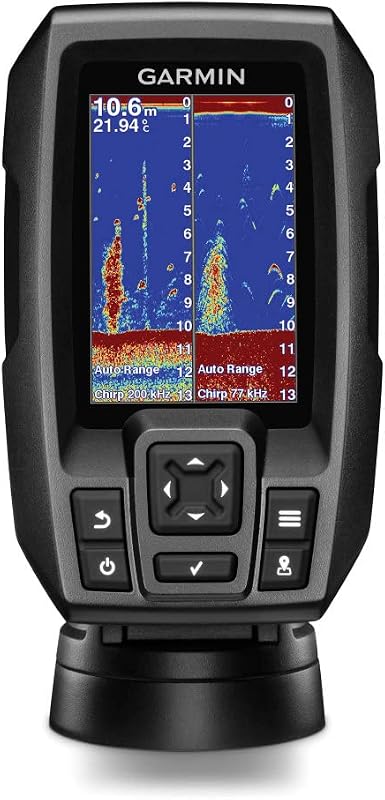
The Garmin Striker 4 is a small GPS fish finder with a 3.5 in color screen, traditional CHIRP sonar, and a built-in flasher view, sold with a dual-beam transducer and mounts for a transom or trolling motor. It suits jon boats and kayaks where the goal is to read depth, see fish arches and bottom, and mark spots to find again. Garmin lists no lake charts and no down-scanning or side-scanning view for it. If those limits fit how you fish, it is a simple way to add sonar and GPS to a small boat.
This Garmin Striker 4 review is research-based: we read Garmin’s product page and owner’s manual, the full Amazon listing, and the owner reviews on it, and we flag where the listing and Garmin disagree.
This guide is general product information, not repair or electrical safety advice. Follow the installation, wiring, and charging instructions in your product’s manual, stop using any battery, charger, or electronics that overheat, swell, or smell of burning, and contact the manufacturer.
We earn a commission from qualifying purchases made through links on this page. Commissions never affect our rankings or AnglerTechLab Scores.
Garmin Striker 4 with Dual-Beam Transducer


As an Amazon Associate I earn from qualifying purchases.
Garmin Striker 4 at a Glance
Sources: Garmin’s Striker 4 product page (G), the Garmin STRIKER Series owner’s manual (M), and the Amazon listing (L).
| Spec | Garmin Striker 4 (010-01550-00) |
|---|---|
| Display | 3.5 in diagonal (about 1.9 x 2.9 in), HVGA color, 480 x 320 pixels (G) |
| Sonar | Traditional CHIRP with a dual-beam transducer; traditional 50/77/200 kHz and CHIRP mid and high (G) |
| Transmit power | 200 W (RMS) (G) |
| GPS and navigation | Built-in GPS; 5,000 waypoints, 50 tracks, 100 routes (G); no preloaded charts listed |
| Maximum depth | 1,600 ft freshwater, 750 ft saltwater (L) |
| Power | 10 to 20 V DC input, typical draw 0.23 A, maximum 1.0 A (G); 12 V DC recommended (M) |
| Controls and build | Keyed buttons, IPX7 water rating, head unit 0.5 lb (G) |
| In the box | Head unit, dual-beam transducer, transom and trolling motor mounts, tilt/swivel mount, power cable (G); no battery |
| Warranty | 1-year limited (L) |
What We Like
- Useful GPS. Garmin lists room for 5,000 waypoints, 50 tracks, and 100 routes, enough to mark brush piles, docks, and the ramp.
- Flasher view built in. Garmin pitches it for “stationary fishing, such as ice fishing or jigging for crappie.”
- Speed on screen. Garmin describes the readout as a way to hold the right trolling speed for a lure.
- Sharp for its size. 480 x 320 pixels on 3.5 in, more total pixels than the 272 x 480 Garmin lists for the 4.3 in Striker Plus 4cv.
What Could Be Better
- No charts. Garmin lists no preloaded charts or Quickdraw Contours for this model.
- Traditional CHIRP only. Garmin lists no ClearVü or SideVü option for this model, even though the Amazon listing’s first feature line describes ClearVü scanning sonar.
- No battery in the box. You need a 12 V source on the boat or Garmin’s portable kit version.
Sonar: What Traditional CHIRP Shows and What It Does Not
Garmin says CHIRP sends “a continuous sweep of frequencies” instead of one frequency, which draws crisper fish arches with better target separation. Garmin also lists Fish Symbol ID, auto gain, bottom lock, split-screen zoom, and sonar history rewind, which lets you scroll back and mark a spot you already passed.
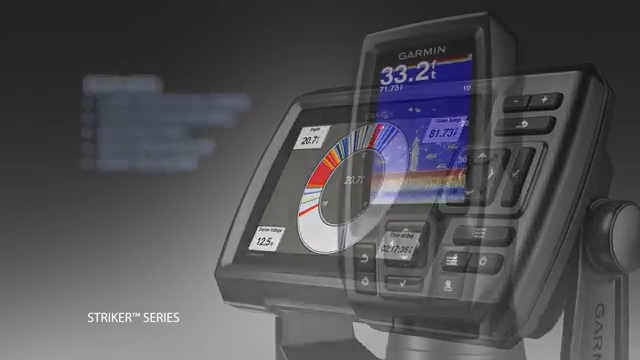
Two views help when you sit still. Per the STRIKER Series manual, the flasher page shows returns on a circular depth ring colored by signal strength, and the A-scope adds a vertical flasher on the right edge of the sonar screen that can help you spot fish close to the bottom.
Garmin’s Striker 4 page offers only Traditional CHIRP, so it lists no picture-like view of structure. The series manual covers ClearVü and SideVü screens, noting that ClearVü needs a compatible transducer and SideVü a compatible transducer and fishfinder. The one sonar upgrade Garmin lists for this unit is high-performance CHIRP with a GT8 or GT15 transducer, sold separately.
GPS, Waypoints, and Speed Without Charts
Garmin pitches the built-in GPS as what sets the Striker apart from a regular fish finder. Per the series manual, one key marks your present location from any screen, and the waypoint map shows your position against your saved marks. It also describes routes, a recorded track, a man overboard mark that sets a direct course back, and sharing waypoints with other STRIKER and echoMAP units, which needs the data wires on the power cable connected per Garmin’s installation instructions.
The series manual lists shallow water, deep water, fish, anchor drag, and low device voltage alarms. One owner with a fiberglass hull sets depth alarms to stay out of the shallows. An alarm only reflects the water under the transducer, so it will not warn you about a stump or ledge ahead of the bow.
The trade-off is a map that is blank apart from your own data: your track shows where you have driven, not where the channel runs. That works on a home lake you keep marking; on new water, you will want charts.
How to Think About the 3.5 in Screen
The 3.5 in figure is the diagonal; Garmin gives the visible area as about 1.9 x 2.9 in. That is enough for full-screen sonar, but a sonar and map split leaves two small windows, even though the manual lets you resize them. Within arm’s reach on a kayak, the size is easy to live with; from the bow of an 18 ft boat with the unit at the console, the numbers can be hard to read at a distance. One owner calls the screen very clear, and the series manual’s split-zoom view magnifies part of the water column next to the full view.
Power and Mounting: Plan for 12 V
Garmin lists a 10 to 20 V DC input with a typical draw of 0.23 A; the manual says the unit will not turn on below 10 V and recommends 12 V. The power cable carries an inline fuse, and the manual points to the cable label or installation instructions for its size. Follow Garmin’s installation instructions, and leave anything beyond them to a marine electrician.
The transducer cable is 20 ft long, per Garmin. Garmin also sells a portable kit version of the Striker 4, with a rechargeable battery and charger, a carrying bag, a suction cup transducer mount, a kayak in-hull transducer mount, and a foam float. If you will move the unit between boats or take it on the ice, compare that version first.
What Owners Say
We read the eight owner reviews available for this listing; some date back several years. Four describe installation or mounting as easy or quick, including one who mounted it on a trolling motor rather than drilling the hull and one who likes that the head unit clicks in and out of its bracket. Three point to the depth, speed, and battery voltage readouts. Two say the screen is easy to read, one in full sun with sunglasses on.
One owner, on a second unit, calls it “perfect for small craft,” and a kayak angler calls it portable and well suited to a kayak, where space is tight. A boater who does not fish uses the GPS track to map lake shorelines and depth alarms to keep a fiberglass hull out of the shallows, notes the lack of charts, and wishes they had bought a Striker Plus cv model for contour mapping and ClearVü.
The complaints are specific. One owner received a unit with power problems; Garmin replaced it under an exchange, and the replacement worked. Another found the battery leads thin and wanted more detail on the power hookup in the directions. Reports on high-speed use are mixed: one owner says the unit cuts out when you try to go fast, while another says it reads depth at high speeds.
How It Compares
Garmin Striker Plus 4cv. Garmin’s UK page for this model (sold there with a different transducer) lists a 4.3 in screen at 272 x 480 pixels, 300 W (RMS) transmit power, ClearVü scanning sonar alongside traditional CHIRP, and Quickdraw Contours, which builds your own 1 ft contour maps for up to 2 million acres. Garmin’s US page did not open when we checked. Choose it to record lake contours or see structure as an image; choose the Striker 4 if arches, depth, and waypoints are enough.
Deeper PRO+ 2. A castable sonar with no screen; it streams over Wi-Fi to a phone app. Deeper lists three beams (7, 20, and 47 degrees), a depth range of 15 cm to 100 m (about 330 ft), built-in GPS, and up to 9 hours per charge; the Amazon listing says the GPS builds bathymetric maps from shore. It suits bank anglers and ice hole hoppers; the Striker 4 suits anglers who want a fixed screen on a boat.
Both appear in our roundup of the best fish finders, and you can browse every unit we cover in the fish finders section.
Who Should Look Elsewhere
- You fish unfamiliar water. Without charts, it cannot show drop-offs you have not driven over.
- You want structure as a picture. Pick a unit that lists down or side imaging.
- You mainly fish through the ice. Look at the portable kit version, or at our ice fishing fish finder roundup. If you are weighing a dial flasher against an LCD unit, see our flasher vs fish finder comparison.
- You prefer Lowrance. Our Lowrance fish finder lineup comparison covers the HOOK Reveal, Eagle, and Eagle Eye models.
Why You Should Trust Us
We do not conduct our own product trials. This review draws on Garmin’s Striker 4 product page and STRIKER Series owner’s manual, the Amazon listing, and the eight owner reviews we could read on that listing, and we note where a figure comes only from the listing. The AnglerTechLab Score starts from Amazon owner ratings, with a limited editorial adjustment explained on our How We Review page. The Striker 4’s score is 0.2 lower because its listing describes ClearVü scanning sonar, which Garmin does not list for this model. Commissions never affect our recommendations or scores.
Final Verdict
The Garmin Striker 4 fish finder does a short list of things well: traditional CHIRP sonar, GPS waypoints and routes, a speed readout, and a flasher view on a small, sharp screen, with mounts in the box. Garmin lists no charts or imaging views for it. Buy it for a small boat or kayak on water you know, with a 12 V source ready.
Frequently Asked Questions
How do you read a Garmin Striker 4 fish finder?
Per the STRIKER Series manual, sonar data scrolls from right to left, auto range keeps the bottom in the lower third of the screen, and the depth scale runs down the right edge. Fish show as arches or symbols, depending on your Fish Symbols setting, and the screen also shows depth, water temperature, GPS speed, and device voltage. On the flasher page, returns light up on a ring, colored by signal strength.
How do you use the Garmin Striker 4 for the first time?
Hold the power key to turn it on and wait for the GPS icon at the top of the home screen, which the manual says appears once satellites are acquired. Pick a sonar view and press the waypoint key to save a spot. Our suggestion is to start with auto gain and auto range, both described in the manual. A simulator mode in the system settings, per the manual, lets you learn the menus before you launch.
Is the Garmin Striker 4 a depth finder or a fish finder?
Both. As a Garmin Striker 4 depth finder, it shows bottom depth on every sonar screen; as a fish finder, it marks fish as arches or symbols. The Amazon listing gives a maximum depth of 1,600 ft in freshwater and 750 ft in saltwater.
Does the Garmin Striker 4 have maps?
No preloaded charts are listed; the waypoint map shows only your position, saved waypoints, routes, and track.
Can you use the Garmin Striker 4 for ice fishing?
Garmin positions it for ice fishing with extra gear: it says the flasher suits ice fishing, but the base kit has no battery or float, and the portable kit version adds both.
About the author

Mason McKinney enjoys fishing Minnesota's lakes for crappie, walleye, and other freshwater species. He uses forward-facing sonar, GPS fish finders, and spot-lock trolling motors to locate fish around underwater structures and maintain precise boat positioning.