
Flasher vs Fish Finder for Ice Fishing: Which Type Fits How You Fish
Flasher vs fish finder for ice fishing: how a dial flasher and a GPS-equipped LCD unit differ in display, power, and mapping, and who each suits.
 Updated October 23, 2026

If you fish one hole at a time and mainly want to watch your lure and the fish that rise to it as it happens, a flasher is the faster, simpler tool to read. If you hop between many holes, want GPS waypoints to find a spot again, or prefer a screen that keeps a short history of what passed under the transducer, an LCD fish finder with a flasher view covers more ground. That is the short answer to the flasher vs fish finder question for ice fishing. The rest of this comparison explains the trade-offs, using two representative units: the Vexilar FL-8se Genz Pack, a classic three-color flasher, and the Garmin Striker Plus 4 Ice Fishing Bundle, a color fish finder with GPS and a 4.3-inch display, per Garmin.
Both types send sound down the hole and display what comes back. The difference is presentation: a flasher fish finder shows returns as lit segments on a round dial in real time, while an LCD unit draws a scrolling picture and adds mapping and waypoints.
This guide is general product information, not repair or electrical safety advice. Follow the installation, wiring, and charging instructions in your product’s manual, stop using any battery, charger, or electronics that overheat, swell, or smell of burning, and contact the manufacturer. No fish finder or camera can tell you whether ice is safe to stand on, so check local ice conditions before every trip.
The Two Units in This Comparison
We chose one unit from each category so the comparison stays concrete. They stand in for the two device types and are not a ranking. The score on each card is its AnglerTechLab Score, calculated with the published method on our How We Review page, not the result of a head-to-head comparison.
We earn a commission from qualifying purchases made through links on this page. Commissions never affect our rankings or AnglerTechLab Scores.

Vexilar FL-8se Genz Pack Flasher
As an Amazon Associate I earn from qualifying purchases.

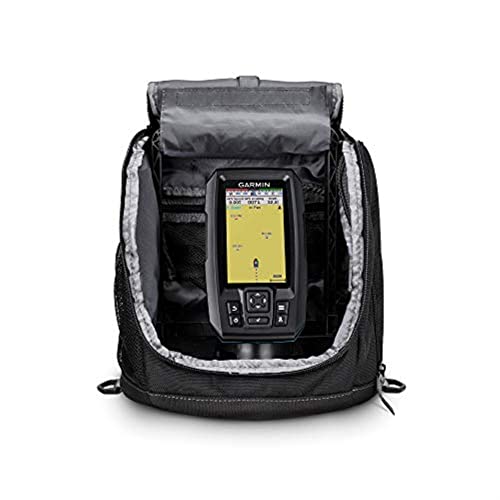
Garmin Striker Plus 4 Ice Fishing Bundle

As an Amazon Associate I earn from qualifying purchases.
Flasher vs Fish Finder: Specs Side by Side
Sources: Vexilar’s product page, Garmin’s bundle page, the Striker Plus 4 Ice Fishing Bundle installation instructions, the Garmin Striker Plus owner’s manual, and the two Amazon listings. Where no source states a figure, the cell says so.
| Feature | Vexilar FL-8se Genz Pack (flasher) | Garmin Striker Plus 4 Ice Fishing Bundle (LCD) |
|---|---|---|
| Display | Three-color LED dial, 525 segments of resolution (per Vexilar) | 4.3 in color display, 272 x 480 pixels (per Garmin) |
| Flasher view | Dedicated flasher; green for weak targets, orange for medium, red for strong bottom returns (per Vexilar) | Built-in flasher page (per the Striker Plus manual); flasher page on a circular depth scale plus an A-Scope vertical flasher (per the Garmin manual) |
| Transducer | 19-degree Ice-Ducer, 200 kHz (per Vexilar) | Dual Beam-IF, CHIRP 77 and CHIRP 200 kHz; 45 degrees at 77 kHz and 15 degrees at 200 kHz (per Garmin) |
| Depth ranges | Six ranges, up to 120 ft (per the listing) | Not confirmed |
| Interference rejection | 10-step adjustment (per Vexilar) | Interference setting from off through low, medium, and high (per the Garmin manual) |
| GPS and mapping | Not mentioned in the listing or on Vexilar’s page | Built-in GPS and Quickdraw Contours mapping (per the listing and Garmin) |
| Battery | 12-volt, 9 amp-hour battery with charger (per Vexilar; the Amazon listing says 7 amp-hour) | Sealed lead-acid, 7 Ah; up to 11 hours (per Garmin) |
| Carry system | Genz Pack case with a base that fits on a five-gallon bucket (per Vexilar) | Portable mount with handle, carried in a zippered bag (per Garmin) |
| Weight | Not confirmed | 8.59 lb fully assembled (per Garmin) |
How Each One Displays the Sonar Signal
A flasher shows only the present moment. As each sonar return comes back, a lit band appears on the dial at the matching depth, and it disappears as soon as the target leaves the cone. There is no history and no picture to interpret, just light at a depth: the bottom stays put, your lure shows up as a small band, and a fish shows up as a band that moves toward it.
On the FL-8se, Vexilar describes a three-color LED display that “shows weak targets in green, medium strength targets in orange and strong bottom targets in red,” with 525 segments of resolution. A band that shifts from green toward orange or red is a stronger return.
An LCD fish finder draws a scrolling chart instead. In the Garmin Striker Plus owner’s manual, the Traditional sonar view shows the depth of detected objects “as the screen scrolls from the right to the left.” Sitting still over a hole, that chart becomes a record of the last few seconds: a fish that came in and left is still visible.
Garmin’s bundle page states that the kit “includes a built-in flasher,” and the manual’s Flasher page describes it as a circular depth scale, organized as a ring that starts at the top and runs clockwise, where “the colors indicate different strengths of the sonar return.” The manual also describes an A-Scope, a vertical flasher along the right side of the full-screen sonar view that expands the most recent sonar data and can help with fish close to the bottom. So a fish finder with flasher capability gives you both styles on one screen.
Reading Depth, Bottom, and Your Bait
How clearly either type separates a small lure from a fish near the bottom depends heavily on the transducer cone. The Vexilar pack uses a 19-degree Ice-Ducer, and the listing describes target ID down to 1 inch. The Garmin’s Dual Beam-IF transducer gives you a choice of a wide 45-degree beam or a narrow 15-degree beam. Per the Garmin manual, wider beams can show more targets and narrower beams give better bottom definition; on the ice, that means more water watched versus a tighter view of your lure.
Sensitivity matters as much as the cone. Garmin’s manual notes that increasing gain shows more detail and decreasing it reduces clutter. The FL-8se listing describes an adjustable sensitivity control; one owner says the dial and switches are simple enough to adjust gain and range with gloves on, and another says that with the proper gain the unit shows everything they need. If other anglers nearby run sonar, both units offer interference controls, with Vexilar listing finer steps on paper.
Portability and Power on the Ice
Both units ship as complete ice kits with a battery, charger, and carrying system. The Genz Pack comes assembled and has a base designed to sit on top of a five-gallon bucket, per Vexilar, with a built-in holder that fits Vexilar’s Ice-Ducer transducers, according to the Amazon listing. Garmin’s kit uses a portable mount with a handle inside a zippered bag, and its transducer cable runs through a float so the transducer hangs beneath the bottom edge of the ice.
Vexilar’s page does not state a weight with a unit, and the Amazon listing’s figure is one we could not confirm, so we left it out. One FL-8se owner says the case handle made it manageable to carry out in one trip, though the case felt a little bulky in a sled already packed with an auger and other gear.
Power is where the display type shows up. Garmin’s instructions note that run time varies with backlight brightness and temperature and that lowering the backlight helps extend battery life, so an LCD user who wants a full day on one hole should plan on a dimmer screen. Vexilar does not publish a run time on the page we opened; two owner reviews describe a full day or more per charge, which is an owner report rather than a specification. Whichever kit you choose, charge it with the included charger in a ventilated area, as Garmin’s battery warnings direct for its kit.
Mapping and GPS: Where a Fish Finder Pulls Ahead
A flasher tells you what is under the hole you are standing over and nothing about where that hole is; neither the FL-8se listing nor Vexilar’s page mentions GPS or mapping. The Striker Plus 4 bundle includes built-in GPS and Quickdraw Contours mapping, according to the Amazon listing, and Garmin’s announcement of the ice bundles says Quickdraw can create and store up to 2 million acres of maps with 1-foot contours. The manual adds that Quickdraw needs both sonar depth and your GPS position, and that you can save a waypoint directly from a sonar screen.
For ice anglers, the everyday payoff is waypoints. If you drill a line of holes across a point or a weed edge, you can mark the ones that produced and walk back to them next weekend, even after snow covers the old holes. Building contour maps takes covering water, so treat Quickdraw as a bonus on hard water. One limit: Garmin describes the bundled transducer as CHIRP traditional sonar, and the manual says ClearVü scanning sonar requires a compatible transducer, so do not expect ClearVü views from this bundle as shipped.
Who Should Skip Each Type
Skip a flasher if you want to save locations, move across a large lake, or review what swam through after you looked away. A flasher has no position data and no record of the last few seconds.
An LCD fish finder isn’t for you if all you want is a single live dial to watch. On the Garmin, the flasher is one of several views you switch between, and the manual notes that some models need the Flasher page added to the Home screen before you can use it. On a 4.3-inch screen, split views also leave each pane small, so judge whether that size works for your eyes.
Which Should You Buy?
- You sit over one or two holes and jig all day: a dedicated flasher such as the Vexilar FL-8se Genz Pack, with its three-color dial and bucket-top base. One owner who drills with a hand auger says that once the ice gets thick, the flasher is how they confirm the right depth and the right spot on fish.
- You run and gun across many holes: an LCD fish finder with GPS, such as the Garmin Striker Plus 4 Ice Fishing Bundle, so you can mark productive holes as waypoints.
- You are new to ice fishing and want one device: the LCD bundle gives you both a flasher view and a scrolling chart, so you can learn which you prefer without buying twice.
- You fish in deep cold and want simple controls: a flasher. One FL-8se owner says the dial and switches are easy to adjust for gain and range with gloves on.
- You want maps of a lake you fish every season: only the GPS unit offers Quickdraw Contours.
If neither unit fits, a ranked list of the best ice fishing fish finders covers more flashers and portable LCD kits, and the ice fishing section collects everything we cover for hard water.
Why You Should Trust Us
We do not conduct our own product trials. This comparison draws on the makers’ product pages and manuals, the Amazon listing for each unit, and the owner reviews we could read. Each AnglerTechLab Score starts from Amazon owner ratings, with a limited editorial adjustment where a listing conflicts with the maker’s published specifications. We earn a commission from qualifying purchases, and commissions never affect our rankings, recommendations, or scores. You can read the full method on our How We Review page.
Frequently Asked Questions
How does a flasher fish finder work?
A transducer hanging in the hole sends sound pulses down, and each echo lights a band on a round dial at the depth it came from, with color or intensity showing how strong the return is. The dial updates continuously and keeps no history, as described in the display section above.
Is a fish finder with flasher mode as good as a dedicated flasher?
It shows the same kind of information: the Garmin Striker Plus manual describes a flasher page on a circular depth scale and an A-Scope vertical flasher. The practical difference is that a dedicated flasher does one job with a dial and physical controls, while an LCD unit adds a scrolling chart and GPS, and its flasher page is one of several views you switch between in the menus, per the Garmin manual.
How do you read a flasher?
In general terms, the bottom is the strongest band, your lure is a thin band above it, and a fish is a band that appears and moves toward the lure. Range and gain setup, and how to tell a fish from interference, are covered step by step in a separate guide on using a flasher.
Can an ice fish finder flasher tell me how thick the ice is?
No. Neither a flasher nor an LCD fish finder measures ice thickness or tells you whether ice will hold your weight. Check local ice conditions before every trip and follow the ice guidance published by your state wildlife agency.
Which is easier for a beginner, a flasher or an LCD fish finder?
It depends on how you learn. A flasher has fewer controls, but it takes some time on the ice to recognize what each band means; one FL-8se owner says the old-style display was intimidating at first and easy to use once on the ice. An LCD fish finder looks more familiar if you have used one in a boat.
About the author

Isaac Banks enjoys fishing for walleye and smallmouth bass on Lake Erie and other Great Lakes waters. He relies on GPS fish finders, CHIRP sonar, and trolling motors to track underwater structure, maintain boat control, and fish efficiently in changing conditions.