
Garmin Striker Vivid 5cv Review: ClearVü and Contour Mapping on a 5 in Screen
Our Garmin Striker Vivid 5cv review covers the 5 in screen, ClearVü with the GT20-TM transducer, Quickdraw contours, 12 V power, and who should skip it.
 Updated October 23, 2026
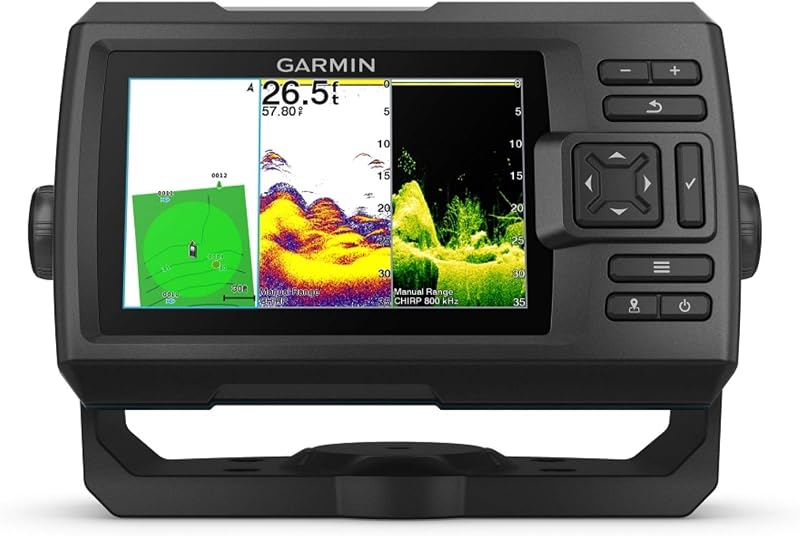
The Garmin Striker Vivid 5cv is a 5 in GPS fish finder that pairs traditional CHIRP sonar with CHIRP ClearVü scanning sonar, and this version ships with the GT20-TM transducer that runs both. It adds Quickdraw Contours, so you can build 1 ft contour maps of the water you fish, but Garmin lists no preloaded charts, no SideVü, and no Wi-Fi for this model. For a jon boat, bass boat, or kayak on a lake you already know, it is a step up from a basic 2D unit.
This Garmin Striker Vivid 5cv review is research-based: we read Garmin’s product page for part 010-02551-00, Garmin’s GT20-TM transducer page, and the STRIKER Vivid series owner’s manual, then checked them against the Amazon listing.
This guide is general product information, not repair or electrical safety advice. Follow the installation, wiring, and charging instructions in your product’s manual, stop using any battery, charger, or electronics that overheat, swell, or smell of burning, and contact the manufacturer.
We earn a commission from qualifying purchases made through links on this page. Commissions never affect our rankings or AnglerTechLab Scores.
Garmin Striker Vivid 5cv with GT20-TM Transducer


As an Amazon Associate I earn from qualifying purchases.
Garmin Striker Vivid 5cv at a Glance
Sources: Garmin’s Striker Vivid 5cv product page (G), Garmin’s GT20-TM transducer page (T), the STRIKER Vivid owner’s manual (M), and the Amazon listing (L).
| Spec | Garmin Striker Vivid 5cv with GT20-TM (010-02551-00) |
|---|---|
| Display | 5.0 in diagonal (about 2.6 x 4.3 in), WVGA color, 800 x 480 pixels (G) |
| Head unit sonar | Traditional 50/77/200 kHz, CHIRP mid and high, ClearVü 260/455/800 kHz (G) |
| Included transducer | GT20-TM: traditional 77/200 kHz, ClearVü 455 and 800 kHz, depth and water temperature (T) |
| Transducer maximum depth | 1,900 ft traditional, 750 ft ClearVü (T) |
| Transmit power | 500 W (RMS) (G) |
| GPS and memory | Built-in GPS with WAAS; 5,000 waypoints, 50 tracks, 50,000 track points, 100 routes (G) |
| Mapping | Quickdraw Contours with 1 ft contours, up to 2 million acres, user-generated (G); no preloaded charts listed |
| Power | 12 to 20 V DC input, typical draw 0.40 A, maximum 1.5 A (G); 3 A fast-acting fuse (M) |
| Controls and build | Keyed buttons, IPX7 water rating, weight 1.0 lb, 7.4 x 4.5 x 2.1 in, flush or tilt/swivel mounting (G) |
| In the box | Fishfinder, GT20-TM transducer, power/data cable, tilt/swivel mount, hardware, documentation (G); Garmin’s box list shows no battery |
| Warranty | 2-year limited (L) |
What We Like
- A sharper screen. Garmin lists 800 x 480 pixels on the 5 in display, against 480 x 320 on the 3.5 in Striker 4.
- ClearVü in the box. The included GT20-TM runs both traditional CHIRP and ClearVü, so the down view needs no extra transducer.
- Your own contour maps. Quickdraw Contours records 1 ft contours as you drive, with room for up to 2 million acres, per Garmin.
What Could Be Better
- No preloaded charts listed. Garmin’s spec list shows none, and its footnote on Quickdraw says those maps do not contain detailed mapping and are user-generated.
- No side imaging. Garmin’s sonar options put SideVü on the Striker Vivid 7sv and 9sv, not the 5cv.
- No Wi-Fi listed. Garmin lists a Wi-Fi network for the 7cv but not the 5cv, and the series manual says the ActiveCaptain app needs Wi-Fi.
- No battery in the box. A kayak or portable setup needs its own 12 V source.
Sonar: Traditional CHIRP Plus ClearVü
Per the series manual, a traditional transducer emits a conical beam, while ClearVü emits a beam “similar to the shape of the beam in a copy machine” for “a clearer, picture-like image of what is beneath the boat.” That is the view you want when idling across a brush pile or a rock hump.
Garmin lists the GT20-TM’s ClearVü beam as 2.5 x 53 degrees at 455 kHz and 1.6 x 29 degrees at 800 kHz, so the 800 kHz beam is narrower in both directions. The manual says higher frequencies use narrower beams and can show better bottom definition, while lower frequencies cover more water and reach deeper.
The series manual describes a flasher page, a ring-style depth display that some models must first add to the Home screen, and recommends the Auto scroll speed for ClearVü, which matches the scroll rate to boat speed so targets look less distorted.
Quickdraw Contours and GPS
Quickdraw Contours is how this model builds maps without preloaded charts. Per the series manual, it draws contours with depth labels as you drive, and a colored circle around the boat icon rates each pass: green for good depth and GPS data under 10 mph, yellow from 10 to 20 mph, and red when depth or GPS position is poor and speed is above 20 mph. A recording offset corrects for a lake level that has changed between trips.
The manual says Garmin makes no representations about the accuracy of user-generated maps, so treat contours as a guide. It also says recording needs “a memory card with free space,” but Garmin’s 5cv spec list shows no card slot, so confirm with Garmin where Quickdraw data is stored before you count on it.
Per the series manual, one key saves a waypoint from any screen, and you can build routes and follow a saved track back to the ramp. It warns that a Go To course is a straight line that may cross land or shallow water, so steer by what you see.
The series manual lists shallow water, deep water, fish, anchor drag, and device voltage alarms, among others, and notes that the beeper must be on for them to sound. A depth alarm reads only the water under the transducer, so it will not warn you about a stump or ledge ahead of the bow.
The 5 in Screen and Controls
The 5.0 in figure is the diagonal; Garmin gives the visible area as about 2.6 x 4.3 in. The series manual lets the 5, 7, and 9 in models build combination pages with a chosen layout and resizable windows, such as ClearVü beside traditional sonar. Control is by keys, not touch.
Power, Mounting, and Portable Use
Garmin lists a 12 to 20 V DC input with a typical draw of 0.40 A and a maximum of 1.5 A. The series manual says the unit will not turn on below 12 V DC, so plan on a battery that stays at or above 12 V. The power cable carries an inline fuse on the red wire, and the manual lists a 3 A fast-acting fuse. The manual also says to refer to the label on the cable or the installation instructions for the exact fuse size, so check the label on your power cable or the installation instructions that ship with your unit. Follow Garmin’s installation instructions, and leave anything beyond them to a marine electrician.
The GT20-TM comes with transom and trolling motor mounts, a 20 ft cable, and installation instructions. Garmin lists transom angles from 0 to 70 degrees and says to follow the instructions carefully to avoid damaging your boat.
Garmin’s 5cv page links to its Portable Fishing Kit as an add-on, which lists a carrying bag, a suction cup transducer mount, a foam float, and a rechargeable battery with a charger. Garmin says its optional kayak in-hull mount secures a GT20-TM inside a kayak. A Garmin press release announced a separate Striker Vivid 5cv Ice Fishing Bundle; check current availability, because we could not confirm that Garmin still sells it.
How It Compares
The closest Garmin alternatives are the Striker 4 and the Striker Plus 4cv. All figures below come from the same spec lines on each model’s Garmin page. The Plus 4cv’s US page did not open when we checked, so its figures come from Garmin’s UK page for part 010-01871-01, which lists a GT20-TM and did not show it as available when we checked; the US version may differ.
| Spec (Garmin) | Striker 4 | Striker Plus 4cv (UK page) | Striker Vivid 5cv |
|---|---|---|---|
| Display | 3.5 in, 480 x 320 pixels | 4.3 in, 272 x 480 pixels | 5.0 in, 800 x 480 pixels |
| Sonar | Traditional CHIRP | Traditional CHIRP and ClearVü | Traditional CHIRP and ClearVü |
| Transmit power | 200 W (RMS) | 300 W (RMS) | 500 W (RMS) |
| Quickdraw Contours | Not listed | Yes, 1 ft contours | Yes, 1 ft contours |
| Weight (per Garmin) | 0.5 lb | 0.3 kg (about 0.7 lb) | 1.0 lb |
| Power input | 10 to 20 V DC | Not listed on the UK page | 12 to 20 V DC |
Garmin Striker 4. Choose it if arches, depth, and waypoints are enough; it is the lightest of the three, with a 10 V minimum against the Vivid 5cv’s 12 V. Our Garmin Striker 4 review covers its limits.
Garmin Striker Plus 4cv. Same two sonar types and Quickdraw Contours on a smaller, lower-resolution screen. The Vivid 5cv asks for a heavier unit in exchange for its larger, sharper screen.
For other screen sizes and brands, see our roundup of the best fish finders, or browse every unit we cover in the fish finders section.
Who Should Look Elsewhere
- You fish unfamiliar water. Without preloaded charts, it cannot show a drop-off you have not driven over.
- You want side imaging or phone app features. Look at the Vivid 7sv or 9sv for SideVü, or the 7cv for Wi-Fi.
- You mostly fish through the ice. Start with our ice fishing fish finder roundup, or look at Garmin’s separate ice fishing bundle (see above).
- You fish from the bank. A castable sonar that streams to your phone may fit better; see our Garmin Striker Cast review.
- You have no 12 V battery aboard. The unit will not turn on below 12 V and ships without a battery; Garmin’s portable kit adds one.
- You prefer Lowrance. Our Lowrance fish finder lineup comparison covers the HOOK Reveal, Eagle, and Eagle Eye models.
Why You Should Trust Us
We do not conduct our own product trials. This review draws on Garmin’s Striker Vivid 5cv and GT20-TM pages, the STRIKER Vivid series manual, and the Amazon listing; we mark figures that come only from the listing. The AnglerTechLab Score starts from Amazon owner ratings, with a limited editorial adjustment explained on our How We Review page. The Striker Vivid 5cv’s score has no editorial adjustment. Its listing gives an Item Weight of 3.8 lb and Garmin lists a weight of 1.0 lb; Garmin does not publish a boxed weight, so we do not treat the gap as a listing error.
Final Verdict
The Garmin Striker Vivid 5cv fish finder makes sense when you want ClearVü and your own contour maps on a sharp 5 in screen, on water you already know, with a steady 12 V source. If you need charts, SideVü, or Wi-Fi, look at another model.
Frequently Asked Questions
What transducer comes with the Garmin Striker Vivid 5cv?
This version includes the GT20-TM, per Garmin. The Garmin Striker Vivid 5cv transducer covers both traditional sonar and ClearVü. Garmin lists one 4-pin transducer port on the 5cv, so check that any replacement uses the 4-pin connector.
Does the Garmin Striker Vivid 5cv have maps?
Garmin lists no preloaded charts; the map shows your own Quickdraw Contours, waypoints, routes, and tracks.
Can you use the Garmin Striker Vivid 5cv for ice fishing?
Garmin’s 5cv page suggests adding a portable ice fishing kit. Garmin describes the included GT20-TM as a transom or trolling motor transducer, though, so if ice is your main season, compare the Garmin Striker Vivid 5cv ice fishing bundle and its transducer first.
What power does the Garmin Striker Vivid 5cv need?
Garmin lists a 12 to 20 V DC input, and the manual says it will not turn on below 12 V DC.
About the author

Mason McKinney enjoys fishing Minnesota's lakes for crappie, walleye, and other freshwater species. He uses forward-facing sonar, GPS fish finders, and spot-lock trolling motors to locate fish around underwater structures and maintain precise boat positioning.