
Best Ice Fishing Fish Finders: 7 Picks From Flashers to Castables
Seven ice fishing fish finders compared, from portable LCD kits and dial flashers to castable sonar, with published specs and who should skip each one.
 Updated October 31, 2026

Choosing the best ice fishing fish finder starts with how you fish the ice. Some anglers want a portable LCD kit with a built-in flasher view and GPS for moving between holes. Others want a classic dial flasher for instant jigging feedback, or a castable sonar that drops through a hole and streams to a phone. For most anglers, our pick is the Garmin Striker Plus 4 Ice Fishing Bundle, because Garmin ships it as a complete ice kit: the fishfinder, a dual-beam ice transducer with a foam float, a rechargeable battery, a charger, and a carrying bag.
We compared seven units across four styles, including one boat-mount fish finder that can work on the ice once you add portable power. Specs come from the maker’s product page or manual where we could open it, and from the Amazon listing where we say so. Fish finder, flasher, ice fishing depth finder: the names for ice fishing electronics overlap, so the buying guide below explains what each style shows and when each one makes sense.
This guide is general product information, not repair or electrical safety advice. Follow the installation, wiring, and charging instructions in your product’s manual, stop using any battery, charger, or electronics that overheat, swell, or smell of burning, and contact the manufacturer. No fish finder or camera can tell you whether ice is safe to stand on, so check local ice conditions before every trip.
Our Top Picks at a Glance
- Best Overall: Garmin Striker Plus 4 Ice Fishing Bundle. A complete ice kit with GPS waypoints, a 4.3 in color screen, and a dual-beam ice transducer whose beam widths and battery runtime Garmin publishes in its manual.
- Best Bucket-Top Flasher: Vexilar FL-8se Genz Pack. The only pick whose base, per the Amazon listing, sits on top of a five-gallon bucket, paired with a three-color, 525-segment flasher dial.
- Largest Built-In Screen: Humminbird HELIX 5 CHIRP G3 Ice Sonar System. A 5 in color display per the listing, compared with 4.3 in on the Garmin bundle and 3.5 in on the Striker 4.
- Deepest-Listed Flasher: Humminbird ICE 55 Flasher. A 200 ft maximum depth per its listing, compared with the 120 ft maximum the Vexilar listing shows (both figures from Amazon listings).
- Lightest Castable: Garmin Striker Cast. 2.6 oz per Garmin, versus 3.2 oz for the Deeper PRO+ 2 per its listing, with a dedicated ice fishing flasher mode in its phone app.
- Deeper-Reading Castable: Deeper PRO+ 2. Deeper lists a depth range to 100 m (about 330 ft), compared with 150 ft for the Striker Cast, plus built-in satellite positioning.
- Boat-Mount Option With Flasher View: Garmin Striker 4. Ships with transom and trolling motor mounts for open water and has a built-in flasher view for vertical jigging, but needs a separate portable kit for the ice.
Ice Fishing Fish Finders Compared
Each cell names its source: the maker’s page, manual, or help center (Garmin, Vexilar, Deeper, Humminbird) or the Amazon listing. Scroll sideways on a phone to see every column.
| Model | Style | Display | Transducer and beams | Depth | Power | GPS | Cold-weather spec |
|---|---|---|---|---|---|---|---|
| Garmin Striker Plus 4 Ice Fishing Bundle | Portable LCD kit with flasher view | 4.3 in color (Garmin overview), 272 x 480 pixels (Garmin specs) | Dual Beam-IF ice transducer, CHIRP 77 and 200 kHz, 45 and 15 degrees (Garmin) | Not listed | 7 Ah sealed lead-acid, up to 11 hr (Garmin) | Yes (Garmin) | Battery operates from 5°F (Garmin) |
| Vexilar FL-8se Genz Pack | Flasher | Three-color LED dial, 525 segments (Vexilar) | 19 degree Ice-Ducer, 200 kHz (Vexilar) | Six ranges (Vexilar), maximum 120 ft (listing) | 12 V, 9 Ah battery with charger (Vexilar) | Not listed | Not listed |
| Humminbird HELIX 5 CHIRP G3 Ice Sonar System | Portable LCD ice system | 5 in color, 800 x 480 pixels (Humminbird manual) | XI 9 1521 ice transducer with Dual Spectrum CHIRP (listing) | 400 ft (Humminbird manual) | 9 Ah battery and charger (listing); 12 V sealed lead-acid (Humminbird) | Not confirmed | Not listed |
| Humminbird ICE 55 Flasher | Flasher | Six-color fiber optic dial with center LCD depth readout (listing) | XI 9 19, 240 and 455 kHz (Humminbird) | 200 ft (listing) | 9 Ah battery and charger (Humminbird) | Not listed | Not confirmed |
| Garmin Striker Cast | Castable sonar, phone app | Your phone or tablet | 260/455 kHz; beams 22 x 63 degrees at 260 kHz and 9 x 14 degrees at 455 kHz (Garmin) | Under 2 ft to 150 ft (Garmin) | Built-in lithium-ion, about 10 hr of typical use (Garmin) | No, sold as a separate GPS version (Garmin) | Operates from -4°F, charges from 41°F (Garmin) |
| Deeper PRO+ 2 | Castable sonar, phone app | Your phone or tablet | Three beams: 675 kHz at 7 degrees, 240 kHz at 20 degrees, 100 kHz at 47 degrees (Deeper) | About 6 in to 330 ft (Deeper) | 950 mAh lithium-ion, up to 9 hr (Deeper) | Yes (Deeper) | Operates from -4°F (Deeper) |
| Garmin Striker 4 | Boat-mount LCD with flasher view | 3.5 in color, 480 x 320 pixels (Garmin) | Dual-beam CHIRP 77/200 kHz with boat mounts (Garmin) | 1,600 ft freshwater (listing) | 10 to 20 V DC input, no battery in the box (Garmin) | Yes (Garmin) | Not listed |
How We Chose
We started with units sold new on Amazon in the United States by established marine electronics makers, then kept the ones whose listing or maker page describes ice use: an ice transducer, an ice flasher mode, or a portable ice kit. A sonar head alone or a mounting accessory did not qualify, because this roundup is about complete units you can fish with.
For each model we read the maker’s product page and manual where we could open them and the full Amazon listing. Where the listing had owner reviews, we read those too; two of the seven listings had none, so those entries rely on specifications alone. We weighed five things: what ships in the box for ice use, transducer beam widths where published, battery type and published cold-weather limits, screen size and controls, and problems owners mention. Where a listing and a maker page disagree, we use the maker’s figure and say so.
We rank by how ready each unit is for the ice straight out of the box: complete ice kits and dedicated flashers first, castable sonars next, and the boat-mount unit, which needs a separate portable kit, last. We do not conduct our own product trials; our picks draw on published specifications, maker manuals, owner reviews where a listing has them, and Amazon owner ratings. Those ratings form the base of each product’s AnglerTechLab Score, with a limited editorial adjustment explained on our How We Review page. For more hard-water gear, see our ice fishing section.
We earn a commission from qualifying purchases made through links on this page. Commissions never affect our rankings or AnglerTechLab Scores.
The order of these products is explained in the article. The AnglerTechLab Score starts from Amazon customer ratings, with a limited editorial adjustment explained on our How We Review page.
| Award | Product | AnglerTechLab Score About AnglerTechLab ScoreThe AnglerTechLab Score is calculated with the published method on our How We Review page. Learn more › | |
|---|---|---|---|
 Garmin Striker Plus 4 Ice Fishing Bundle |
8.9/10 | Buy | |
 Vexilar FL-8se Genz Pack Flasher |
8.6/10 | Buy | |
 Humminbird HELIX 5 CHIRP G3 Ice Sonar System |
8.4/10 | Buy | |
 Humminbird ICE 55 Flasher |
8.4/10 | Buy | |
 Garmin Striker Cast Castable Sonar |
8.4/10 | Buy | |
 Deeper PRO+ 2 Castable Sonar |
7.9/10 | Buy | |
 Garmin Striker 4 with Dual-Beam Transducer |
8.6/10 | Buy |
Garmin Striker Plus 4 Ice Fishing Bundle
A portable ice kit built around the Striker Plus 4 fishfinder. Garmin lists a 4.3 in color display with built-in GPS, a Dual Beam-IF ice transducer (CHIRP 77 and 200 kHz), and a carrying bag with foam float, rechargeable battery, and charger; the Striker Plus manual describes a flasher page.
Pros
- Ice transducer, float, battery, charger, and bag in one box, per Garmin
- Two beam widths, 45 and 15 degrees, per Garmin's install guide
- GPS waypoints and Quickdraw Contours mapping
- Works on open water with an optional GT8 or GT15 transducer, per Garmin
Cons
- Sealed lead-acid battery; Garmin lists about 10 to 12 hours to recharge
- Garmin's battery operating range starts at 5°F
- Smaller screen than 5 in portable ice systems
Vexilar FL-8se Genz Pack Flasher
A three-color flasher in Vexilar's Genz Pack case. Vexilar lists 525 segments, six depth ranges, 10-step interference rejection, a 19 degree Ice-Ducer transducer, and a 12 V, 9 Ah battery with charger.
Pros
- Three-color real-time dial with adjustable sensitivity, per the listing
- 10-step interference rejection, per Vexilar
- Case base fits on a five-gallon bucket, per the listing
- Two-year warranty with one year on the battery, per Vexilar
Cons
- No GPS, maps, or sonar history
- Maximum depth is 120 ft, per the listing
- No built-in battery gauge; the listing names an optional indicator
Humminbird HELIX 5 CHIRP G3 Ice Sonar System
A portable ice system with a 5 in color display, according to the listing. The listing describes Dual Spectrum CHIRP sonar, flasher, A-Scope, and zoom ice views, plus an ice transducer, ICE shuttle, 9 Ah battery, charger, and bag in the box.
Pros
- 5 in color display, per the listing
- Several ice views, including flasher and A-Scope
- CHIRP interference rejection, per the listing
- Ships as a complete portable kit, per the listing
Cons
- The listing shows 12 lb without saying whether that is carry or shipping weight
- The listing says GPS applies to select models only
Humminbird ICE 55 Flasher
A six-color fiber optic flasher with a center LCD depth readout, according to the listing. The listing describes dual frequency sonar with selectable beams, adjustable gain and zoom, a 200 ft maximum depth, and a carrying case.
Pros
- Digital depth readout beside the flasher dial
- 200 ft maximum depth, per the listing
- 240 and 455 kHz beams and a 9 Ah battery, per Humminbird
- Some owners report little interference next to other brands
Cons
- The listing's included-items field names the ICE 45, so check what ships
- Two owners find the two-cord float setup harder to manage
- One owner reports the transducer plug loosening when moving between holes
Garmin Striker Cast Castable Sonar
A castable sonar that streams to the free Striker Cast phone app. Garmin lists 2-D and ice fishing flasher modes, a depth range from under 2 ft to 150 ft, about 10 hours per charge, and a weight of 2.64 oz.
Pros
- Very light, with no wired transducer or separate battery pack
- Ice fishing flasher mode in the app
- Usable from shore, a kayak, or a boat after ice-out
- Powers on when floating and off when removed, per Garmin
Cons
- Needs a phone or tablet as the screen
- Garmin lists charging only from 41°F
- No GPS on this version; Garmin sells a separate GPS model
Deeper PRO+ 2 Castable Sonar
A castable Wi-Fi sonar with built-in GPS that streams to the Fish Deeper app. Deeper lists three beams, a depth range to 100 m (about 330 ft), up to 9 hours per charge, and use as an ice fishing flasher for hole hopping.
Pros
- Three beams, from 7 to 47 degrees, per Deeper
- Depth range to about 330 ft, per Deeper
- Built-in GPS for mapping from shore
- Operating range down to -4°F, per Deeper
Cons
- Needs a phone as the screen
- Owners recommend a stout rod and heavy line for casting it
- App setup and pairing needed before first use
Garmin Striker 4 with Dual-Beam Transducer
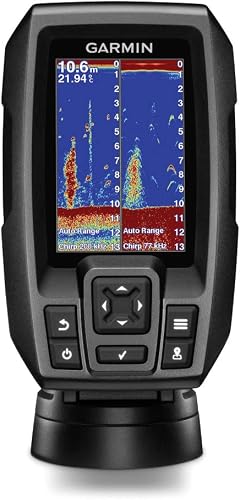
A compact 3.5 in GPS fishfinder sold with boat mounts. Garmin lists a 480 x 320 pixel color display, a CHIRP 77/200 kHz transducer, and a built-in flasher view for vertical jigging and ice fishing.
Pros
- Built-in GPS for marking waypoints
- Flasher view for stationary jigging, per Garmin
- Includes transom and trolling motor mounts
- Keyed button controls, per Garmin
Cons
- No battery, charger, or float in the box for ice use
- Small 3.5 in screen
- Garmin sells the portable kit for ice use separately
Ice Fishing Fish Finder Reviews
1. Garmin Striker Plus 4 Ice Fishing Bundle (Best Overall)
Who it’s for: Anglers who want one box that is ready for the ice on day one, and who want GPS waypoints to find productive holes again on flat, featureless ice.
Standout features: Per Garmin’s product page, the bundle includes the Striker Plus 4 fishfinder, a Dual Beam-IF transducer, and a portable kit with a bag, foam float, rechargeable battery, and charger. Garmin’s overview describes a 4.3 in color display with built-in GPS, and Quickdraw Contours mapping with 1 ft contours; the Striker Plus manual describes a flasher page. The installation instructions list the ice transducer at CHIRP 77 and 200 kHz, with a 45 degree beam at 77 kHz and a 15 degree beam at 200 kHz. The same document lists a 7 Ah sealed lead-acid battery rated for up to 11 hours and an assembled kit weight of 8.59 lb.
The instructions are also specific about cold. At 32°F, Garmin lists 10.5 hours of runtime at full screen brightness and 26.5 hours at 50%, so dimming the screen is the simplest way to stretch a long day. Garmin also notes the fishfinder works on open water if you add a GT8 or GT15 transducer, each sold separately.
- Pro: Battery, charger, float, bag, and ice transducer all ship in the box, per Garmin.
- Pro: GPS waypoints and contour mapping, which dial flashers do not offer.
- Pro: A path to open-water use with an optional Garmin transducer.
- Con: The instructions list about 10 to 12 hours to fully charge a depleted battery.
- Con: The Amazon listing describes the display as WVGA, while Garmin lists it as QSVGA at 272 x 480 pixels; we use Garmin’s figure.
Who should look elsewhere: If you often fish in temperatures below 5°F, note that Garmin’s installation instructions put the bottom of the battery’s operating range at 5°F. If you sit over one hole and jig for hours, a dial flasher like the Vexilar FL-8se gives a simpler, always-live readout. If you walk far between spots, the castable units weigh ounces instead of pounds.
2. Vexilar FL-8se Genz Pack (Best Bucket-Top Flasher)
Who it’s for: Jiggers who fish from a bucket, want a classic three-color flasher, and do not need GPS or a sonar history.
Standout features: Vexilar’s product page lists a three-color LED display with 525 segments, six depth ranges, 10-step interference rejection, a 200 kHz frequency, a 19 degree Ice-Ducer transducer, target ID down to 1 inch, and a 12 V, 9 Ah battery with charger. Vexilar lists a two-year warranty, with one year on the battery. According to the Amazon listing, the maximum depth is 120 ft, the display shows weak targets in green, medium targets in orange, and strong returns in red, and the Genz Pack base fits on top of a five-gallon bucket with a built-in holder for Ice-Ducer transducers. The listing’s description mentions a 7 Ah battery; we use the 9 Ah figure from Vexilar’s page.
- Pro: Dial and switch controls that one owner describes as easy to adjust with gloves on.
- Pro: Ten interference rejection steps for crowded ice, per Vexilar.
- Pro: Bucket-top base keeps the unit at eye level while you sit.
- Con: No GPS, no screen history, and no built-in battery gauge (the listing names a battery status indicator as an optional accessory).
- Con: The listing’s 120 ft maximum is shallower than the 200 ft the ICE 55 listing shows.
What owners say: Owners on this listing describe it as easy to use; one says setup is just dropping the transducer in the hole, adjusting for depth, and jigging. One owner who uses a hand auger said the flasher helps confirm depth and position before committing to drilling through thick ice. Another wrote that a charge lasted from sunrise into the afternoon, while also calling the case bulky in a sled already packed with an auger. One owner wished for a battery life indicator, and another replaced the foam float with a hook to hang the transducer.
Who should look elsewhere: Anglers who want to mark waypoints or review what passed under the hole should pick an LCD kit such as the Striker Plus 4 bundle. If you regularly fish water deeper than 120 ft, the ICE 55 listing shows a deeper range.
3. Humminbird HELIX 5 CHIRP G3 Ice Sonar System (Largest Built-In Screen)
Who it’s for: Anglers who fish from a shelter and want a bigger color screen than the Garmin units.
Standout features: According to the Amazon listing, this system uses a full-color 5 in display with Dual Spectrum CHIRP sonar, 3/4 in target separation, CHIRP interference rejection, adjustable sonar zoom, and a Jig Charge mode. The listing’s ice views include flasher, A-Scope, and zoom. It lists an ice transducer with an 8 ft cable, an ICE shuttle, a 9 Ah battery and charger, and a portable bag in the box. Humminbird lists the ICE HELIX 5 CHIRP G3 among its current ICE products, and its HELIX operations manual gives a 5 in, 800 x 480 pixel screen and a 400 ft depth capability for the XI 9 1521 ice transducer; the other specs here come from the listing.
- Pro: The largest built-in LCD in this roundup, per the listing.
- Pro: Flasher, A-Scope, and zoom ice views, per the listing.
- Con: The listing shows 12 lb without saying whether that is the carry or shipping weight, so check before you buy.
- Con: The listing says built-in GPS applies to “select models,” so GPS on this version is not confirmed.
Who should look elsewhere: If you want GPS waypoints you can count on, or specs confirmed by the maker before you buy, the Garmin Striker Plus 4 bundle is the safer choice. Anglers who walk long distances may prefer a castable sonar that weighs a few ounces.
4. Humminbird ICE 55 Flasher (Deepest-Listed Flasher)
Who it’s for: Flasher users who fish deep basins and want a digital depth readout next to the dial.
Standout features: According to the Amazon listing, the ICE 55 uses a six-color fiber optic flasher dial with a center LCD that shows a digital depth reading and sets the depth scale automatically. The listing describes dual frequency sonar with user-selectable beams, adjustable gain and zoom, a maximum depth of 200 ft, a carrying case, and a two-year manufacturer warranty. Its included-items field names an “ICE 45 Flasher” instead, so confirm the model on the box when it arrives. Humminbird lists the ICE 55 among its current ICE flashers and, in its ICE flasher overview, says it comes with a 9 amp-hour battery and charger and the XI 9 19 ice transducer, which uses 240 kHz and 455 kHz beams. The 200 ft depth figure is from the listing. Because of the ICE 45 mix-up in the listing, its AnglerTechLab Score includes a 0.2 deduction.
- Pro: The deepest flasher range in this roundup at 200 ft, per the listing.
- Pro: Digital depth readout, plus a zoom that one owner says works anywhere in the water column.
- Con: The listing’s included-items field names a different model, so check what ships.
- Con: Two owners describe the separate signal and support cords as harder to manage than a single-cord arm.
What owners say: Two owners on this listing say they ran it in the same shelter or tournament as other brands’ flashers with little or no interference, which one attributes to Humminbird running on a different frequency. One owner reported fishing 10 hours straight with 40% of the battery left. Complaints are specific: one owner said the transducer plug on the back loosened when moving between holes, and two preferred a single-cord transducer arm to the foam float and double cord.
Who should look elsewhere: Panfish anglers in shallow water do not need the deeper range, and the Vexilar is simpler. Anyone who wants GPS or maker-confirmed specs should choose the Garmin bundle.
5. Garmin Striker Cast (Lightest Castable)
Who it’s for: Anglers who walk to their spots, drill many holes, or want one sonar that also works from shore and a kayak after ice-out.
Standout features: Garmin’s Striker Cast page says the castable sonar streams to the free Striker Cast app on a phone or tablet, offers traditional 2-D and ice fishing flasher modes, and works in freshwater, saltwater, “and even for ice fishing.” The owner’s manual specifications list a 60 m (200 ft) wireless range, a weight of 2.64 oz, and an included 16 ft tether. The manual lists an operating range from -4°F to 140°F but a charging range from 41°F to 104°F, so charge it at home or in a heated vehicle. This version has no GPS; Garmin sells a separate Striker Cast GPS.
- Pro: The lighter of the two castables, with no wired transducer or separate battery pack to carry.
- Pro: Dedicated ice flasher mode, plus open-water use the rest of the year.
- Con: Your phone is the screen, so it has to stay charged and warm enough to run.
- Con: The listing says the tether is 20 ft; Garmin lists 16 ft, and we use Garmin’s figure.
What owners say: A few owners on this listing say they use it for ice fishing. One of them praised the battery life but said it picked up interference near other sonar and doubted it reaches the full advertised connection range. Another owner warned that the charging cable uses an uncommon connector, so it is worth keeping in a safe spot. One kayak angler found the fish marks confusing in clear, shallow water and relied mainly on its depth and water temperature readings.
Who should look elsewhere: If you want a dedicated screen you can read with gloves on, or you fish deeper than 150 ft, choose a portable LCD kit or the Deeper PRO+ 2.
6. Deeper PRO+ 2 (Deeper-Reading Castable)
Who it’s for: Anglers who want a castable sonar that maps from shore in summer and reads deeper water through the ice in winter.
Standout features: Deeper’s product page lists three beams, a depth range from 15 cm to 100 m, a Wi-Fi connection up to 100 m, and support for GPS, GLONASS, Galileo, BeiDou, and QZSS positioning. Deeper lists target separation of 1 cm on the narrow beam and 2.4 cm on the medium and wide beams (about 0.4 in and 0.9 in). The page says that “as an ice fishing flasher, Deeper PRO+ 2 makes hole hopping easier with no transducer or wires.” According to the Amazon listing, it weighs 3.2 oz, builds bathymetric maps from shore, and ships with a neoprene pouch, attachment bolts, and a USB cable.
- Pro: The deeper listed range of the two castable units, about 330 ft versus 150 ft.
- Pro: Built-in satellite positioning for maps made from shore.
- Con: Depends on a phone and a Wi-Fi link, so the phone has to stay charged and warm.
- Con: Slightly heavier than the Striker Cast, at 3.2 oz per the listing versus 2.6 oz per Garmin.
What owners say: Two owners on this listing use it through the ice. One, two years in, says it pairs with the app as soon as it goes into the hole and the battery lasts all day; the other likes carrying it from hole to hole without a heavy lead battery and reports about 6 hours of battery life. A third owner, who also fished it on the ice, says the unit stopped charging and stopped sending a Wi-Fi signal for a second time after a winter outing, and wonders whether the cold water played a part.
Who should look elsewhere: If you fish shallow lakes and only need depth and a simple flasher mode, the lighter Striker Cast covers it. If you want controls and a screen that work without a phone, choose a flasher or a portable LCD kit.
7. Garmin Striker 4 (Boat-Mount Option With Flasher View)
Who it’s for: Boat anglers who fish open water most of the year and want the same small fishfinder on the ice a few weekends each winter.
Standout features: Garmin’s Striker 4 page lists a 3.5 in diagonal color display at 480 x 320 pixels, built-in GPS, a CHIRP 77/200 kHz transducer, and a 10 to 20 V DC power input. Garmin says the built-in flasher shows the bottom, your jig, and fish entering the beam “anytime you are stationary fishing, such as ice fishing or jigging for crappie.” The box list shows the transducer with transom and trolling motor mounts, a tilt and swivel mount, and a power cable, with no battery or float. The Amazon listing gives a maximum depth of 1,600 ft in freshwater and 750 ft in saltwater, and its only ice reference is the line “Ideal for ice fishing or vertical jigging.”
- Pro: Ships with transom and trolling motor mounts for the boat, per Garmin.
- Pro: Flasher view and GPS waypoints in one compact head unit, listed by Garmin at 0.5 lb.
- Con: No battery, charger, float, or carry case in the box for ice use.
- Con: The 3.5 in screen is the smallest built-in display in this roundup.
What owners say: Owners on this listing describe boat and kayak use rather than the ice. They mention seeing depth, water temperature, speed, and battery voltage on one screen, and two say the head unit clicks in and out of its bracket or is easy to remove and store. One owner found the power leads thin and had to secure them.
Who should look elsewhere: If most of your fishing happens through the ice, this is not the box to buy. Garmin sells a separate portable kit with a battery, charger, and transducer float, so budget for it, or choose the Striker Plus 4 bundle, which includes those parts and an ice transducer.
How to Choose the Best Ice Fishing Fish Finder
Flasher, Portable LCD, or Castable Sonar
Pick a flasher when you jig over one hole and want a live, always-on readout with knobs you can turn in gloves. The Vexilar FL-8se and Humminbird ICE 55 are the two flashers here. If you go with a flasher, a walkthrough of how to read a flasher on the ice is worth a look before your first trip.
A portable LCD kit, such as the Garmin Striker Plus 4 bundle or the Humminbird HELIX 5 ice system, adds a flasher view on a color screen and sonar history; the Garmin bundle also adds GPS waypoints and Quickdraw contour maps, while GPS on the HELIX 5 ice listing is not confirmed. Choose one if you move between spots or want to return to a hole you found last weekend. Castable sonars like the Striker Cast and Deeper PRO+ 2 trade a dedicated screen for very low weight and summer use from shore, though a phone touchscreen is harder to work in gloves than a dial or keypad.
Transducer Beam and How It Hangs in the Hole
Through the ice, the transducer hangs straight down, so beam width decides how much water you see under the hole. A wide beam, like the 45 degree setting on the Garmin ice transducer or the 47 degree beam on the Deeper, covers more bottom and shows fish moving in from the side. A narrow beam, like Garmin’s 15 degree setting or Deeper’s 7 degree beam, shows less area in more detail, which helps when you are watching a small jig. Vexilar’s single 19 degree Ice-Ducer sits between the two, and Garmin lists oval beams for the Striker Cast (22 x 63 degrees at 260 kHz, 9 x 14 degrees at 455 kHz).
Check how the transducer hangs. Garmin’s ice bundle instructions tell you to set the float and float stop so the transducer hangs below the bottom edge of the ice.
Battery Type and Cold-Weather Limits
Garmin’s Striker Plus 4 bundle uses a 12 V sealed lead-acid battery. Vexilar’s page and the ICE 55 listing give 12 V, 9 Ah batteries without naming the chemistry; Humminbird’s ICE HELIX installation guide lists a 12 volt sealed lead-acid battery for the ICE HELIX kit. Garmin’s installation instructions note that its sealed lead-acid battery holds a charge for a shorter time in the cold, list 5°F as the bottom of the battery’s operating range, and say to use only the included Garmin 12 V DC charger and not to charge the battery in an unventilated area.
Castable sonars carry small lithium-ion batteries instead. Garmin lists the Striker Cast as operating down to -4°F but charging only from 41°F, and Deeper lists an operating range down to -4°F. On a subzero day the phone can be the weak link, so keep it in an inside pocket between looks.
Interference on Crowded Ice
When several anglers fish close together, sonar units can pick up each other’s signals. If you fish busy shelter villages, look for a published interference rejection control, such as the 10 steps Vexilar lists for the FL-8se or the CHIRP interference rejection the HELIX 5 listing describes.
Frequently Asked Questions
Can you use a regular boat fish finder for ice fishing?
Often, yes, if it has a flasher or vertical view and you add portable power and a way to hang the transducer straight down. The Garmin Striker 4 above is an example: Garmin describes its flasher for ice fishing but sells the battery, charger, and float as a separate portable kit.
Is an ice fishing depth finder the same as a fish finder?
Every unit in this roundup reads depth, but a basic depth finder may show only a number. A fish finder or flasher also shows the bottom, your lure, and fish in the beam, which is what helps you decide whether to keep jigging or move.
Do castable sonars work through the ice?
Both castables here are sold for it. Garmin says the Striker Cast works “even for ice fishing” and offers an ice flasher mode, and Deeper describes the PRO+ 2 as an ice fishing flasher for hole hopping. Either way, your phone has to handle the cold.
Can I use a Garmin ice fishing fish finder on open water?
Garmin says the Striker Plus 4 from its ice bundle works on open water if you add a GT8 or GT15 transducer, each sold separately.
Is a flasher better than an LCD for ice fishing?
Neither is better for everyone: choosing between a flasher versus an LCD fish finder comes down to how often you change holes and whether you want GPS waypoints.
About the author

Isaac Banks enjoys fishing for walleye and smallmouth bass on Lake Erie and other Great Lakes waters. He relies on GPS fish finders, CHIRP sonar, and trolling motors to track underwater structure, maintain boat control, and fish efficiently in changing conditions.