
Best Budget Fish Finders: 5 Picks Under $500 for Boats, Kayaks, and Shore
Five budget fish finders under $500 by maker list price, compared on screen, sonar, GPS, and depth range: castable sonars and mounted down imaging units.
 Updated October 31, 2026
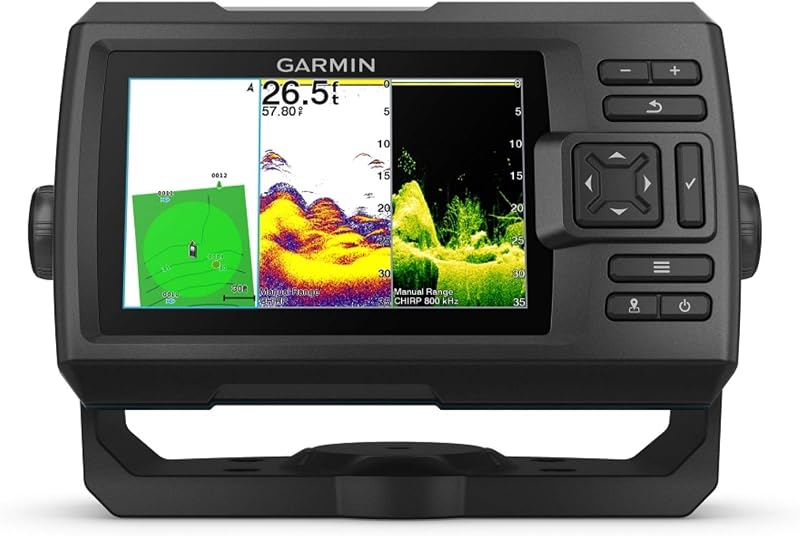
The best budget fish finder depends on where you fish. In this roundup, budget means a maker list price under $500 on the maker’s own website, an editorial cutoff we set rather than an industry standard. A mounted unit gives you a real screen, down imaging, and GPS on a jon boat or bass boat. A castable sonar streams to your phone, so you can scan from a dock, the bank, or a kayak with nothing to wire.
Our pick is the Garmin Striker Vivid 5cv: a mounted 5.0 in unit with CHIRP traditional and ClearVü down imaging sonar, GPS, and 5,000 waypoints, per Garmin. We compared it with the larger Striker Vivid 7cv, the castable Garmin Striker Cast GPS, and two Deeper castables. All five carry a maker list price below $500.
This guide is general product information, not repair or electrical safety advice. Follow the installation, wiring, and charging instructions in your product’s manual, stop using any battery, charger, or electronics that overheat, swell, or smell of burning, and contact the manufacturer.
Best Budget Fish Finders at a Glance
- Best Overall: Garmin Striker Vivid 5cv. Down imaging, CHIRP, and GPS in a 1.0 lb head unit with 0.40 A typical current draw, per Garmin.
- Castable with Quickdraw Contours: Garmin Striker Cast GPS. The only castable here that records Garmin Quickdraw contour maps (1 ft contours) and lists 5,000 waypoints, per Garmin.
- Largest Screen: Garmin Striker Vivid 7cv. A 7.0 in display versus 5.0 in on the other mounted unit; the castables use your phone.
- Longest Depth Range Among Castables: Deeper PRO+ 2. Deeper lists 100 m, against 150 ft for the Striker Cast GPS and 165 ft for the Deeper Start.
- Single-Beam Castable: Deeper Start. One 40 degree beam and no GPS listed by Deeper; the only single-beam unit here.
Fish Finders Under $500 Compared
All figures come from the makers’ own pages and manuals (Garmin, Deeper). Scroll sideways on a phone to see every column.
| Model | Type | Screen | Sonar | Depth range | GPS and maps | Power |
|---|---|---|---|---|---|---|
| Garmin Striker Vivid 5cv | Mounted | 5.0 in, 800 x 480 pixels | CHIRP traditional and ClearVü, 500 W (RMS) | 1,900 ft traditional, 750 ft ClearVü (GT20-TM transducer) | GPS with WAAS, 5,000 waypoints, Quickdraw Contours | 12 to 20 V DC, 0.40 A typical |
| Garmin Striker Cast GPS | Castable | Your phone or tablet | Traditional 2-D, 260/455 kHz, flasher mode | Under 2 ft to 150 ft | GPS with WAAS, 5,000 waypoints, Quickdraw Contours | Built-in battery, 10 hours typical |
| Garmin Striker Vivid 7cv | Mounted | 7.0 in, 800 x 480 pixels | CHIRP traditional and ClearVü, 500 W (RMS) | 1,900 ft traditional, 750 ft ClearVü (GT20-TM transducer) | GPS with WAAS, 5,000 waypoints, Quickdraw Contours, Wi-Fi | 12 to 20 V DC, 0.55 A typical |
| Deeper PRO+ 2 | Castable | Your phone or tablet | Three beams: 7, 20, and 47 degrees | 15 cm to 100 m (about 0.5 to 330 ft) | GPS, GLONASS, Galileo, BeiDou, QZSS; app maps | Built-in battery, up to 9 hours |
| Deeper Start | Castable | Your phone or tablet | One beam, 120 kHz, 40 degrees | 1.6 ft to 165 ft | GPS not listed by Deeper | Built-in battery, up to 6 hours |
How We Chose
We kept fish finders sold new in the U.S. from makers whose own sites list a price below $500 for the exact version, checked on each maker’s U.S. store. Store prices move, so check the price where you buy. We read each listing in full and took specs from Garmin’s U.S. product pages and Striker Cast manual and from Deeper’s product pages; none of the Garmin pages marks its model discontinued. For a wider field at every budget, see our roundup of the best fish finders.
Every unit here clears our budget cutoff of a maker list price under $500. Best Overall goes to the Striker Vivid 5cv: it is the main pick for anglers who fish from a boat, with down imaging, GPS, and a screen of its own in the smaller and lighter of the two mounted head units. Between the two mounted Vivid units, the 5cv has the lower maker list price, which fits a budget pick, so it takes the spot ahead of the 7cv. After the 5cv come the Striker Cast GPS, the one castable here with Garmin’s contour mapping, then the larger 7cv, then the Deeper castables (longer depth range first). The AnglerTechLab Score is one factor in our assessment; it starts from Amazon owner ratings, with a limited editorial adjustment explained on our How We Review page. Two scores include a 0.2 deduction: the Striker Cast GPS for a listing maximum depth that differs from Garmin’s manual, and the Deeper PRO+ 2 for a listing that gives a display size for a sonar with no screen of its own. We do not run our own product trials. More is in our fish finders section.
We earn a commission from qualifying purchases made through links on this page. Commissions never affect our rankings or AnglerTechLab Scores.
The order of these products is explained in the article. The AnglerTechLab Score starts from Amazon customer ratings, with a limited editorial adjustment explained on our How We Review page.
| Award | Product | AnglerTechLab Score About AnglerTechLab ScoreThe AnglerTechLab Score is calculated with the published method on our How We Review page. Learn more › | |
|---|---|---|---|
 Garmin Striker Vivid 5cv with GT20-TM Transducer |
8.6/10 | Buy | |
 Garmin Striker Cast GPS Castable Sonar |
8.2/10 | Buy | |
 Garmin Striker Vivid 7cv with GT20-TM Transducer |
8.6/10 | Buy | |
 Deeper PRO+ 2 Castable Sonar |
7.9/10 | Buy | |
 Deeper Start Castable Fish Finder |
8.0/10 | Buy |
Garmin Striker Vivid 5cv with GT20-TM Transducer
A 5 in GPS fish finder with traditional CHIRP and CHIRP ClearVü scanning sonar, sold with the GT20-TM transducer. Garmin lists an 800 x 480 pixel display, 500 W (RMS) transmit power, and Quickdraw Contours for building your own 1 ft contour maps. Garmin lists no preloaded charts.
Pros
- 800 x 480 pixel 5 in display, per Garmin
- Included GT20-TM transducer runs traditional CHIRP and ClearVü
- Quickdraw Contours records your own 1 ft contour maps
- 5,000 waypoints and 100 routes on Garmin's spec page
Cons
- No preloaded charts, per Garmin
- No SideVü or Wi-Fi listed for this model
- Needs a 12 V source; the series manual says it will not turn on below 12 V DC
Garmin Striker Cast GPS Castable Sonar
The GPS version of Garmin's castable sonar, streaming to the free Striker Cast phone app. Garmin lists 2-D and ice fishing flasher modes, Quickdraw Contours mapping with 1 ft contours, a depth range from under 2 ft to 150 ft, and about 10 hours per charge.
Pros
- Built-in GPS records your own contour maps, per Garmin
- 5,000 waypoints on Garmin's spec page
- Ice fishing flasher mode in the app
- Powers on when floating and off when removed, per Garmin
Cons
- Needs a phone or tablet as the screen
- Garmin lists charging only from 41°F
- The listing's 200 ft maximum depth conflicts with the 150 ft in Garmin's manual
Garmin Striker Vivid 7cv with GT20-TM Transducer
A 7 in GPS fishfinder with CHIRP traditional and ClearVü scanning sonar. Garmin lists 800 x 480 pixels, Quickdraw Contours mapping with 1 ft contours, and Wi-Fi for the ActiveCaptain app; the included GT20-TM transducer runs both sonars. Garmin lists no preloaded charts.
Pros
- 7 in screen at 800 x 480 pixels, per Garmin
- GT20-TM transducer runs traditional and ClearVü sonar
- Quickdraw Contours records your own 1 ft contour maps
- Wi-Fi for waypoint transfer and Quickdraw Community data, per Garmin
Cons
- No preloaded charts listed
- Garmin lists no SideVü for this model
- Needs a 12 to 20 V DC supply, per Garmin
Deeper PRO+ 2 Castable Sonar
A castable Wi-Fi sonar with built-in GPS that streams to the Fish Deeper app. Deeper lists three beams, a depth range to 100 m (about 330 ft), up to 9 hours per charge, and use as an ice fishing flasher for hole hopping.
Pros
- Three beams, from 7 to 47 degrees, per Deeper
- Depth range to about 330 ft, per Deeper
- Built-in GPS for mapping from shore
- Operating range down to -4°F, per Deeper
Cons
- Needs a phone as the screen
- Owners recommend a stout rod and heavy line for casting it
- App setup and pairing needed before first use
Deeper Start Castable Fish Finder
A castable Wi-Fi sonar that shows depth, bottom contour, and fish icons in the Fish Deeper app. Deeper lists a single 120 kHz, 40 degree beam, a depth range of 0.5 m to 50 m (about 165 ft), and up to 6 hours per charge.
Pros
- No wires or external batteries, per the listing
- Connection range of at least 50 m, per Deeper
- Charges in 2.5 hours, per Deeper
- Very light at 0.07 kg, per the listing
Cons
- Single beam only
- Deeper's operating range starts at 32°F
- GPS not listed by Deeper
Fish Finder Reviews
1. Garmin Striker Vivid 5cv (Best Overall)
Who it’s for: Kayak and small-boat anglers who want a mounted screen with down imaging and GPS but have little room and a small battery.
Standout features: Garmin’s Striker Vivid 5cv page lists a 5.0 in display (about 2.6 x 4.3 in) at the same 800 x 480 pixels as the 7cv, the same CHIRP traditional and ClearVü sonar at 500 W (RMS), and the same 5,000 waypoints and Quickdraw Contours. The head unit weighs 1.0 lb, and Garmin lists 0.40 A typical current draw against 0.55 A for the 7cv. Garmin’s version name includes the GT20-TM transducer. The listing gives an Item Weight of 3.8 lb; Garmin lists no boxed weight, so that figure is not directly comparable with the 1.0 lb unit weight.
- Pro: The 7cv’s sonar and GPS features in a smaller, lighter head unit.
- Pro: Lower typical current draw than the 7cv, per Garmin.
- Con: No Wi-Fi line on Garmin’s spec list, unlike the 7cv.
- Con: No preloaded charts and no SideVü side imaging on Garmin’s spec list.
Who should look elsewhere: If you split the screen between sonar and a contour map most of the time, the 7cv gives each pane more room. Our Garmin Striker Vivid 5cv review covers its setup and sonar views.
2. Garmin Striker Cast GPS (Castable with Quickdraw Contours)
Who it’s for: Shore, dock, and kayak anglers who want depth, fish, and their own contour maps without mounting a transducer or running wires.
Standout features: Garmin’s Striker Cast GPS page describes a castable sonar that streams to the free STRIKER Cast app from up to 200 ft (60 m) away, with traditional 2-D and ice fishing flasher modes. Its built-in GPS records Quickdraw maps with 1 ft contours, and the spec page lists 5,000 waypoints and WAAS. The Striker Cast manual lists a sonar depth range from under 2 ft to 150 ft, 10 hours of typical battery life, and about 1.5 hours to charge, and says contour recording works only on GPS models.
- Pro: Records your own 1 ft contour maps from shore or a kayak, per Garmin.
- Pro: 10 hours of typical battery life and about 1.5 hours to charge, per Garmin’s manual.
- Con: Your phone is the screen, so it has to stay charged and within range.
- Con: The listing gives a 200 ft maximum depth; Garmin’s manual lists 150 ft.
Who should look elsewhere: Boat anglers who run across the lake: Garmin’s manual cautions against towing it faster than 5 mph, while a mounted Striker Vivid reads from its own transducer as you move. Our Garmin Striker Cast review covers the GPS and non-GPS versions side by side.
3. Garmin Striker Vivid 7cv (Largest Screen)
Who it’s for: Jon boat and small bass boat owners who want a screen they can read from the console or the bow while running sonar and a waypoint map side by side.
Standout features: Garmin’s Striker Vivid 7cv page lists a 7.0 in display (about 3.4 x 6.1 in) at 800 x 480 pixels, CHIRP traditional and ClearVü scanning sonar at 500 W (RMS) through the included GT20-TM transducer, and GPS with 5,000 waypoints. Quickdraw Contours records your own maps, and it is the only mounted unit here with Wi-Fi on Garmin’s spec list, for the ActiveCaptain app, which the listing says transfers waypoints and gives access to the Quickdraw Community. The listing gives an Item Weight of 4.4 lb; Garmin lists only the 1.7 lb unit weight and no boxed weight, so the two figures are not directly comparable.
- Pro: Down imaging (ClearVü) and traditional CHIRP from one transducer in the box.
- Pro: Wi-Fi for waypoint transfer to a phone, per Garmin and the listing.
- Con: No preloaded charts listed by Garmin; contour maps come from your own recording or from the Quickdraw Community.
- Con: Garmin’s spec list names ClearVü but no SideVü side imaging for this model.
What owners say: Owners mention easy installation and a box that includes everything needed to set it up. One finds the screen easy to see in bright sunlight, and a kayak angler says it starts reading as soon as the kayak is in the water. One owner expected built-in maps and found none, and says the unit is complicated and takes study time to learn.
Who should look elsewhere: Kayak anglers short on deck space, or anyone who wants to fish from the bank: a castable or the smaller 5cv fits better.
4. Deeper PRO+ 2 (Longest Depth Range Among Castables)
Who it’s for: Bank and pier anglers who fish deep water or switch to ice fishing in winter, and want maps from shore.
Standout features: Deeper’s PRO+ 2 page lists three beams (675 kHz at 7 degrees, 240 kHz at 20 degrees, 100 kHz at 47 degrees), a depth range of 15 cm to 100 m, GPS, GLONASS, Galileo, BeiDou, and QZSS positioning, and its own Wi-Fi with a stable connection up to 100 m. Deeper lists up to 9 hours per charge, 80% charge in 45 minutes, and an operating range of -4°F to 104°F, and describes using it as an ice fishing flasher. The listing gives a 2.4 in display (OLED or small LCD), but the unit has no screen: Deeper’s quick guide says scans show on your smartphone or tablet. That gap costs it 0.2 on our score.
- Pro: Reads deeper than the other two castables, per the makers’ figures.
- Pro: A narrow 7 degree beam for detail and a wide 47 degree beam to cover more bottom, per Deeper.
- Con: Needs a stout rod and heavy line to cast, which owners mention.
- Con: The app pushes paid upgrades each time it starts, one owner says.
What owners say: Pier and bank anglers say it pairs quickly with the app and holds a connection at long casting distances; one uses it from bank to ice and calls the battery good for a full day. A kayak and bank angler reports a cast that snapped the line and recommends heavy braid, and notes paddle churn can show false fish when it is mounted beside a kayak. One owner’s unit stopped charging after the warranty ran out, and they wish Deeper sold replacement batteries.
Who should look elsewhere: Anyone fishing from a moving boat; a mounted Striker Vivid shows the screen without a phone. Our Deeper PRO+ 2 review and our Deeper versus Striker Cast comparison go further on the two castables.
5. Deeper Start (Single-Beam Castable)
Who it’s for: Casual dock and bank anglers, and families on fishing trips, who want depth, bottom contour, and fish icons on a phone.
Standout features: Deeper’s Start page lists one 120 kHz beam at 40 degrees, a depth range of 1.6 ft to 165 ft, 10 scans per second, a Wi-Fi range of at least 165 ft depending on your phone, up to 6 hours per charge, and 2.5 hours to charge. According to the Amazon listing, it saves every scan with time and location so you can revisit spots.
- Pro: One beam and few settings, so there is little to learn.
- Pro: No wires or external batteries, per the listing.
- Con: Deeper does not list GPS for it, so it is the one castable here without a stated mapping feature.
- Con: Deeper lists an operating range from 32°F and does not mention ice fishing.
Who should look elsewhere: To map from shore, fish in freezing weather, or read water deeper than 165 ft, the PRO+ 2 or the Striker Cast GPS.
How to Choose a Budget Fish Finder
What Each Price Band Buys
By maker list price, this group splits in two. The three castables list under $200, and the two mounted units list from $300 to $450. The extra money buys a dedicated screen, down imaging, and a transducer that stays on the boat, not better GPS: every Garmin unit here lists the same 5,000 waypoints. So the best fish finder for the money is the one whose extras you will actually use: if you fish from a boat and want those three things, a mounted unit; if not, a castable. Within the castables, compare beams, GPS, and battery figures in the table above rather than assuming the dearer unit does more.
Mounted Unit or Castable
A mounted unit needs a 12 V battery (Garmin lists 12 to 20 V DC for the Striker Vivid units) and a transducer on the transom or trolling motor, but it reads while you move and puts the picture on its own screen. A castable needs only a charged phone and a rod strong enough to throw it. If you fish from the bank or a pier, a castable is the only type here that works. If you fish from a boat most days, the mounted screen is easier to read at a glance. For a step-by-step version of this choice, see our guide to choosing a fish finder.
Sonar Type and Depth
The Striker Vivid units add ClearVü down imaging (260, 455, and 800 kHz) to traditional CHIRP, which Garmin describes as showing fish and structure below the boat. The castables show traditional 2-D sonar only. None of the five lists side imaging. For deep lakes, check depth range. The mounted units have the most reach: Garmin’s GT20-TM page lists 1,900 ft for traditional sonar and 750 ft for ClearVü. Among the castables, Deeper lists 100 m for the PRO+ 2, while the Striker Cast GPS and Deeper Start top out at 150 ft and 165 ft.
GPS and Maps
Four of the five list built-in GPS; the Deeper Start does not. Garmin’s three units record your own Quickdraw Contours maps and can use contours other anglers share through Garmin’s Quickdraw Community; Deeper’s PRO+ 2 builds maps in its app, and its page describes community-based depth maps as a Premium Maps feature. None of them lists preloaded lake charts, so coverage of new water depends on whether other anglers have already mapped it.
Frequently Asked Questions
What is the best cheap fish finder?
Our pick is the Garmin Striker Vivid 5cv for boat anglers who want down imaging, GPS, and their own screen in a compact mounted unit. For shore, dock, and kayak anglers who want to record Garmin Quickdraw contour maps without wiring, the Striker Cast GPS is the castable to look at (the Deeper PRO+ 2 also builds maps from shore), and the Striker Vivid 7cv has the largest display here. If you only want depth, bottom, and fish icons on a phone, the Deeper Start is the only single-beam unit in this group.
What is a good cheap fish finder for a 12 ft boat?
If the boat carries a 12 V battery, a mounted unit reads while you move. The Striker Vivid 5cv has the smaller and lighter head unit of the two here, and Garmin lists a lower typical current draw for it than for the 7cv. Choose the 7cv if the console has room for the larger screen. If there is no battery on board, a castable needs no wiring, though you cast it or tow it slowly rather than reading at running speed.
Is a castable fish finder good enough on a budget?
For bank, pier, and kayak fishing, yes: it shows depth, bottom, and fish on your phone without wiring. It is a weaker choice on a boat you run across the lake, since you need to cast or tow it slowly and keep the phone in hand.
Do fish finders in this price range have GPS?
Four of the five here do, per their makers’ pages; the Deeper Start is the exception. GPS lets you save waypoints and record contour maps, but none of these units ships with preloaded charts.
How do you understand what a fish finder shows?
Start with depth and the bottom line, then look for arches (fish) and clumps (bait or cover) above it. Our guide to reading a fish finder walks through each view.
Can you use these fish finders for ice fishing?
Two of the castables are described for it by their makers. Garmin lists an ice fishing flasher mode for the Striker Cast GPS, though its manual lists charging only from 41°F. Deeper describes the PRO+ 2 as an ice fishing flasher and lists operation down to -4°F. Deeper lists the Start from 32°F and does not mention ice fishing.
About the author

Mason McKinney enjoys fishing Minnesota's lakes for crappie, walleye, and other freshwater species. He uses forward-facing sonar, GPS fish finders, and spot-lock trolling motors to locate fish around underwater structures and maintain precise boat positioning.