
Best Fish Finder GPS Combos: 5 Picks Compared by Maps and Waypoints
Five fish finder GPS combos compared on preloaded charts, waypoints, and contour maps you record, from a castable Striker Cast GPS to 9 in chartplotters.
 Updated October 31, 2026

The best fish finder GPS combo puts your boat on a chart while the sonar shows what is under it, so you can mark a brush pile, follow a drop-off, and drive back to the same spot next week. Which one fits depends less on the sonar than on the maps: what comes preloaded, what you can record yourself, and how much screen you have to read them on.
We compared five units: two 9 in chartplotters with charts in the box, a Humminbird HELIX 5 with a preloaded basemap, a castable Garmin sonar that maps through a phone app, and a 3.5 in Garmin Striker 4 that stores waypoints but no charts.
This guide is general product information, not repair or electrical safety advice. Follow the installation, wiring, and charging instructions in your product’s manual, stop using any battery, charger, or electronics that overheat, swell, or smell of burning, and contact the manufacturer.
Our Top Picks at a Glance
- Multi-Band GPS, Charts Confirmed by the Maker: Garmin ECHOMAP UHD2 94sv. The only unit here whose maker page or listing names multi-band GPS, and the only one whose preloaded charts we could confirm with the maker.
- Radar-Ready Chartplotter: Simrad GO Chartplotter and Fish Finder (9 in). The only unit here whose listing names radar support; Garmin’s spec list for the 94sv names none.
- Maps Bottom Hardness and Vegetation: Humminbird HELIX 5 CHIRP GPS G3. The only listing here that names bottom hardness and vegetation layers in the maps you record.
- Castable GPS Mapping: Garmin Striker Cast GPS. The only unit here you cast on a line instead of mounting; Garmin lists 1 ft contours for the maps it records.
- Lightest Mounted Unit: Garmin Striker 4. Garmin lists 0.5 lb for the head unit, against 2.1 to 3 lb for the other three mounted units per Garmin and the listings.
Fish Finder GPS Combos Compared
Source: G = Garmin U.S. product page or manual, H = Humminbird HELIX manual, L = Amazon listing. Scroll sideways on a phone to see every column.
| Model | Screen | GPS receiver | Charts in the box | Maps you record | Sharing and links | Source |
|---|---|---|---|---|---|---|
| Garmin ECHOMAP UHD2 94sv | 9.0 in touchscreen, 1024 x 600 pixels | Four satellite systems, multi-band, 10 Hz | Navionics+ U.S. coastal and Great Lakes, tide tables | Quickdraw Contours | Wi-Fi, NMEA 2000, Force trolling motor | G |
| Simrad GO (9 in) | 9 in touchscreen | Built-in GPS, 10 Hz | C-MAP Discover card, U.S. and Canada | Not named | Wi-Fi, NMEA 2000, phone mirroring, radar | L |
| Humminbird HELIX 5 CHIRP GPS G3 | 5 in, 800 x 480 pixels | GPS, no details | Humminbird Basemap, 10,000+ lakes and U.S. coastlines | AutoChart Live: contours, bottom hardness, vegetation | Not listed | H for screen, L for the rest |
| Garmin Striker Cast GPS | Your phone or tablet | GPS with WAAS | None; community maps download | Quickdraw Contours, 1 ft | Streams to the app up to 200 ft (60 m) | G |
| Garmin Striker 4 | 3.5 in, 480 x 320 pixels | GPS with WAAS | None listed | Track and waypoints only | Waypoints and routes with STRIKER and echoMAP | G |
How We Chose
We kept fish finders sold new on Amazon in the U.S. whose listing names built-in GPS or a chartplotter, and read each listing in full. We opened Garmin’s U.S. product pages for the three Garmin units (none is marked discontinued there) and Garmin’s Striker Cast owner’s manual. Simrad’s site blocked our requests, so its specs come from the Amazon listing. For the HELIX 5 we used Humminbird’s HELIX operations manual alongside its listing, and Humminbird lists the model among its current HELIX products. We dropped one unit whose listing named contour mapping but no GPS receiver. For a wider field picked on sonar and screen, see our roundup of the best fish finders.
The order follows how much map comes in the box: preloaded charts first, from the largest screen down (the 94sv, whose charts Garmin confirms, then the 9 in Simrad, then the 5 in HELIX 5), then maps you record, then GPS without charts. We did not name a Best Overall. The Striker 4 and the HELIX 5 already hold that title in other roundups of ours, and we do not give one model that title twice; the Striker Cast GPS is a castable sonar that shows its picture on your phone, not a combo with its own chartplotter screen, so it is not the main kind of product this guide covers; the ECHOMAP has too few owner ratings for our threshold; and Simrad’s specs are unconfirmed by Simrad. The order is editorial, not a sort by score, and the AnglerTechLab Score is shown for reference. It starts from Amazon owner ratings, with a limited editorial adjustment explained on our How We Review page. The Striker 4 and Striker Cast GPS scores each include a 0.2 deduction for a listing claim that Garmin’s own product page or manual contradicts. We do not run our own product trials. More is in our fish finders section.
We earn a commission from qualifying purchases made through links on this page. Commissions never affect our rankings or AnglerTechLab Scores.
The order of these products is explained in the article. The AnglerTechLab Score starts from Amazon customer ratings, with a limited editorial adjustment explained on our How We Review page.
| Award | Product | AnglerTechLab Score About AnglerTechLab ScoreThe AnglerTechLab Score is calculated with the published method on our How We Review page. Learn more › | |
|---|---|---|---|
 Garmin ECHOMAP UHD2 94sv with GT56 Transducer |
8.9/10 | Buy | |
 Simrad GO 9 in Chartplotter and Fish Finder with Transducer |
8.6/10 | Buy | |
 Humminbird Helix 5 CHIRP GPS G3 |
8.6/10 | Buy | |
 Garmin Striker Cast GPS Castable Sonar |
8.2/10 | Buy | |
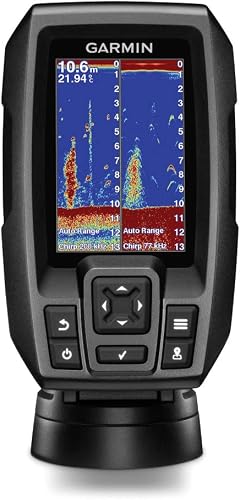 Garmin Striker 4 with Dual-Beam Transducer |
8.6/10 | Buy |
Garmin ECHOMAP UHD2 94sv with GT56 Transducer
A 9 in touchscreen chartplotter and fish finder. Garmin lists 1024 x 600 pixels, multi-band GPS, preloaded Navionics+ U.S. coastal and Great Lakes charts with tide tables, and traditional, ClearVü, and SideVü sonar through the included GT56 transducer.
Pros
- Multi-band GPS with four satellite systems, per Garmin
- Preloaded coastal and Great Lakes charts with tide tables
- Wireless link to a Garmin Force trolling motor, per Garmin
- Traditional, ClearVü, and SideVü sonar built in
Cons
- Large head unit: 10.4 x 6.5 x 3.2 in and 2.9 lb, per Garmin
- Inland lake charts come on the 93sv version instead
- Garmin lists 1.72 A typical current draw at 12 V DC
Simrad GO 9 in Chartplotter and Fish Finder with Transducer
A 9 in touchscreen chartplotter and fish finder, according to the listing, sold with a transducer and a C-MAP Discover chart card covering the U.S. and Canada. The listing names built-in GPS, Wi-Fi, NMEA 2000, CHIRP and DownScan sonar, and support for Simrad radar.
Pros
- C-MAP Discover chart card in the box, per the listing
- Built-in GPS with Wi-Fi and NMEA 2000, per the listing
- Supports Simrad Broadband and Halo radar, per the listing
- Screen mirroring to a phone or tablet, per the listing
Cons
- Listing is unclear on whether the bundled transducer gives side imaging
- Specs not confirmed on the maker's site
- No waypoint capacity given in the listing
Humminbird Helix 5 CHIRP GPS G3
A GPS fishfinder and chartplotter with Dual Spectrum CHIRP sonar, according to the listing. The listing names a Humminbird Basemap of 10,000+ lakes and U.S. coastlines, AutoChart Live mapping, and an XNT 9 HW T transom transducer.
Pros
- Wide and Narrow CHIRP modes, per the listing
- Humminbird Basemap with lakes and coastlines, per the listing
- AutoChart Live maps depth, bottom hardness, and vegetation
- Keypad controls, per the listing
Cons
- No down or side imaging named in the listing
- 5 in screen, per Humminbird, smaller than the HELIX 7 models
Garmin Striker Cast GPS Castable Sonar
The GPS version of Garmin's castable sonar, streaming to the free Striker Cast phone app. Garmin lists 2-D and ice fishing flasher modes, Quickdraw Contours mapping with 1 ft contours, a depth range from under 2 ft to 150 ft, and about 10 hours per charge.
Pros
- Built-in GPS records your own contour maps, per Garmin
- 5,000 waypoints on Garmin's spec page
- Ice fishing flasher mode in the app
- Powers on when floating and off when removed, per Garmin
Cons
- Needs a phone or tablet as the screen
- Garmin lists charging only from 41°F
- The listing's 200 ft maximum depth conflicts with the 150 ft in Garmin's manual
Garmin Striker 4 with Dual-Beam Transducer
A compact 3.5 in GPS fishfinder sold with boat mounts. Garmin lists a 480 x 320 pixel color display, a CHIRP 77/200 kHz transducer, and a built-in flasher view for vertical jigging and ice fishing.
Pros
- Built-in GPS for marking waypoints
- Flasher view for stationary jigging, per Garmin
- Includes transom and trolling motor mounts
- Keyed button controls, per Garmin
Cons
- No battery, charger, or float in the box for ice use
- Small 3.5 in screen
- Garmin sells the portable kit for ice use separately
Fish Finder GPS Combo Reviews
1. Garmin ECHOMAP UHD2 94sv (Multi-Band GPS, Charts Confirmed by the Maker)
Who it’s for: Bass boat and bay boat owners who fish the coast or the Great Lakes and want charts, sonar, and trolling motor control on one screen at the console.
Standout features: Garmin’s ECHOMAP UHD2 9 in sv page lists a 9.0 in touchscreen (about 7.8 x 4.5 in) at 1024 x 600 pixels and a 10 Hz receiver that tracks GPS, GLONASS, Galileo, and BeiDou with multi-band support, which Garmin says improves accuracy where signals are reflected or weak. This version ships with Navionics+ charts for U.S. coastal and Great Lakes waters, tide tables, and a 1-year subscription for daily chart updates. Garmin also lists Quickdraw Contours, 5,000 waypoints, NMEA 2000, and a wireless Force trolling motor link. The GT56 transducer covers traditional, ClearVü, and SideVü sonar.
- Pro: Four satellite systems and multi-band GPS, per Garmin.
- Pro: Sends routes and waypoints to a Force trolling motor without a cable, per Garmin.
- Con: Preloaded charts cover coastal and Great Lakes waters; Garmin lists the inland version as the 93sv.
- Con: A large head unit: Garmin lists 10.4 x 6.5 x 3.2 in and 2.9 lb.
Who should look elsewhere: Inland anglers should ask for the 93sv with lake charts. On a kayak battery, the Striker 4 draws far less: Garmin lists 0.23 A typical for it, against 1.72 A typical at 12 V DC for the 94sv. Our ECHOMAP versus Striker comparison weighs the same trade-off at the 5 in size.
2. Simrad GO Chartplotter and Fish Finder, 9 in (Radar-Ready Chartplotter)
Who it’s for: Owners of center consoles and other larger boats who want charts, sonar, and a path to radar on one 9 in screen; the listing pitches it at sport boats, center consoles, and smaller cruisers.
Standout features: According to the Amazon listing, this 9 in touchscreen chartplotter comes with a transducer and a C-MAP Discover chart card with vector charts, custom depth shading, tides and currents, and high-resolution bathymetric contours across the U.S. and Canada. The description names a built-in 10 Hz GPS receiver, waypoints you mark with a tap and name, Wi-Fi, NMEA 2000, and screen mirroring to a phone or tablet. It also lists plug-and-play support for Simrad Broadband 3G, Broadband 4G, and Halo radar, and says automatic routing is not available in the USA. The description refers to the GO9 XSE; Simrad’s site did not open for us, so we could not confirm which generation ships.
- Pro: Chart card with U.S. and Canada coverage in the box, per the listing.
- Pro: Radar overlay on the chart once you add a Simrad radar, per the listing.
- Con: The listing calls the bundled transducer an 83/200 kHz unit for CHIRP and DownScan, while its description ties side imaging to an optional HDI or TotalScan transducer.
- Con: Specs could not be confirmed with Simrad, and the listing gives no waypoint capacity.
What owners say: One owner whose chart showed no depth data found the installer had left the C-MAP card in the box, and credits Simrad’s support with sorting out the setup; the same owner’s jet boat installer warned that a transom transducer would not read reliably behind the jet exhaust. Another added the unit to an existing Simrad network and reports depth, radar, AIS, and autopilot data showing up with no extra work. One owner could not get side scan to display with the bundled transducer, though they praise the card’s coverage of small local lakes and rivers. Another says the unit lost its stored waypoints and tracks after a few months and now asks for setup on each trip.
Who should look elsewhere: Kayak and jon boat anglers: the listing gives 3 pounds and 10.35 x 3.54 x 7.24 in. If you want specs the maker confirms, the 94sv.
3. Humminbird HELIX 5 CHIRP GPS G3 (Maps Bottom Hardness and Vegetation)
Who it’s for: Anglers on weedy natural lakes who want a map of where the weed lines and hard bottom sit, built as they drive, on top of a preloaded basemap.
Standout features: According to the Amazon listing, this GPS chartplotter carries a Humminbird Basemap of 10,000+ lakes and continental U.S. coastlines and accepts LakeMaster, CoastMaster, and Navionics charts. AutoChart Live records depth contours, bottom hardness, and vegetation as you boat, with eight hours of recording built in; AutoChart Zero Line SD cards expand that capacity. The listing names only 2D Dual Spectrum CHIRP sonar, through an XNT 9 HW T transom transducer.
- Pro: Records bottom hardness and vegetation layers, not just contours, per the listing.
- Pro: Room to add premium LakeMaster, CoastMaster, or Navionics charts, per the listing.
- Con: Built-in AutoChart recording is listed at eight hours; longer mapping needs a Zero Line card.
- Con: The listing gives no waypoint capacity, and we found none in Humminbird’s HELIX manual.
Who should look elsewhere: For an imaging view beside the map, the 94sv lists ClearVü and SideVü, and the Simrad listing names DownScan. Our Humminbird HELIX 5 review covers its sonar and setup in more detail.
4. Garmin Striker Cast GPS (Castable GPS Mapping)
Who it’s for: Shore, dock, and kayak anglers who want to map a pond or small lake without mounting anything, and who already carry a phone.
Standout features: Garmin’s Striker Cast GPS page describes a castable sonar that streams to the free STRIKER Cast app on a phone or tablet from up to 200 ft (60 m) away. Its built-in GPS records Quickdraw maps with 1 ft contours, and the spec page lists 5,000 waypoints and WAAS. The Striker Cast manual says contour recording works only on GPS models, and the app draws a green, yellow, or red circle on the map to show whether depth, GPS position, and speed are good enough to map. There are no preloaded charts, but you can download maps other anglers shared to the Quickdraw Community. Sonar is traditional 2-D with an ice fishing flasher mode.
- Pro: Maps a pond or backwater from shore, with no boat mount or wiring.
- Pro: Records 1 ft contours with its own GPS, per Garmin.
- Con: Your phone is the screen, so the map is only as large and bright as the phone.
- Con: The listing gives a 200 ft maximum depth; Garmin’s manual lists less than 2 ft to 150 ft.
Who should look elsewhere: Anyone who wants charts on a console screen, or plans to map while under power: the manual cautions against towing it faster than 5 mph. Our Garmin Striker Cast review compares the GPS and non-GPS versions, and our Deeper versus Striker Cast comparison covers the other castable option.
5. Garmin Striker 4 (Lightest Mounted Unit)
Who it’s for: Kayak and small-boat anglers on one or two home lakes who want to save spots and watch their speed, and do not need charts.
Standout features: Garmin’s Striker 4 page describes high-sensitivity GPS and a waypoint map that shows your position against the spots you mark, with room for 5,000 waypoints, 50 tracks, and 100 routes. The screen also shows boat speed for holding a trolling pace. There are no charts; the map page shows only what you have saved. The 3.5 in display (about 1.9 x 2.9 in) runs 480 x 320 pixels.
- Pro: The same 5,000-waypoint capacity Garmin lists for the 94sv, in a 0.5 lb head unit.
- Pro: Waypoints and routes carry over to STRIKER and echoMAP units, per Garmin.
- Con: No charts and no contour recording listed, so new water starts as a blank screen.
- Con: Its listing opens with a ClearVü scanning sonar claim that Garmin’s spec page does not support for this model.
What owners say: One owner who boats without fishing uses the GPS track to outline lake shorelines, since the unit has no charts, and names an ECHOMAP with charts as the upgrade they would want. Another uses the speed readout to hold a steady trolling pace of about 1.2 mph. Two others single out the waypoint finder, or having speed, GPS, and depth on one screen.
Who should look elsewhere: For a preloaded lake map on a mounted screen, the HELIX 5. Our Garmin Striker 4 review covers its sonar, flasher view, and setup.
How to Choose a Fish Finder GPS Combo
Preloaded Charts Versus Maps You Record
Preloaded charts show contours, drop-offs, and channels on water you have never fished. Here they come in three packages: Garmin Navionics+ on the 94sv, a C-MAP Discover card with the Simrad, and a Humminbird Basemap on the HELIX 5. These are different products, so check that your lakes or bays are covered rather than comparing lake counts. Maps you record (Quickdraw Contours on the 94sv and Striker Cast GPS, AutoChart Live on the HELIX 5) fill in ponds and backwaters that no chart covers in detail, but only where you have driven or cast.
Screen Size for Chart and Sonar Side by Side
A combo earns its place when chart and sonar share the screen, so each pane gets only part of the display. By Garmin’s dimensions, the 94sv’s screen measures about 7.8 x 4.5 in, so each half of a split view is still larger than the whole Striker 4 display (about 1.9 x 2.9 in). The Simrad listing gives 9 in without a resolution, Humminbird lists the HELIX 5 at 5 in and 800 x 480 pixels, and on the Striker Cast GPS the screen is whatever phone or tablet you bring. For the sonar pane on the Garmin units, our guide to reading a Garmin fish finder explains what each view shows.
GPS, Waypoints, and Sharing
All three Garmin units list 5,000 waypoints on Garmin’s spec pages. The 94sv and the Simrad listing both name a 10 Hz receiver, and the 94sv adds multi-band GPS. If you run two units, Garmin says ECHOMAP UHD2 units share sonar, waypoints, and routes over Wi-Fi, and the Striker 4 shares waypoints and routes with STRIKER and echoMAP units. The Simrad listing names NMEA 2000 links to engines, fuel meters, and sensors. The HELIX 5 listing names GPS without a waypoint count, and we found none in Humminbird’s HELIX manual, so ask Humminbird if you plan to save a long list of spots.
Mounted Combo or Castable Sonar
A mounted combo needs boat power (Garmin lists 9 to 18 V DC for the 94sv) and a transducer on the transom or trolling motor, but the 94sv and HELIX 5 can record contours every time you drive. The Striker Cast GPS needs neither, runs about 10 hours per charge per Garmin, and maps only where you cast or tow it slowly. For a kayak with no battery on board, that is the simpler route; on a boat you run across the lake, a mounted unit records far more water.
Frequently Asked Questions
What is the best fish finder GPS combo?
It depends on your water. For coastal or Great Lakes fishing from a larger boat, the ECHOMAP UHD2 94sv; for a boat that may add radar, the Simrad GO. If you only need to mark and return to spots on water you know, the Striker 4 has GPS without charts.
What is a fish finder GPS plotter?
A fish finder that also plots your position on a chart, usually sold as a chartplotter fishfinder combo. Garmin sells the ECHOMAP units as chartplotters, and the Simrad and HELIX 5 listings call theirs one. A GPS fish finder such as the Striker 4 shows your position against your own waypoints and track, with no chart underneath.
Do you need preloaded charts if you can record your own?
On a home lake, recorded contours may be all you need, since you map the spots you actually fish. On new water, preloaded charts show the drop-offs before you have driven over them. The 94sv and HELIX 5 offer both; the Striker Cast GPS records its own maps and downloads community maps, but has no preloaded charts.
Can a castable sonar with GPS replace a mounted combo?
For shore and kayak fishing on small water, often yes: the Striker Cast GPS saves waypoints and records contours through the app. It has no preloaded charts, and Garmin’s manual warns against towing it faster than 5 mph, so it cannot map a large lake at running speed.
Can a fish finder GPS combo steer a trolling motor?
Some can. Garmin says the 94sv connects wirelessly to a Garmin Force trolling motor to follow routes, navigate to waypoints, and control speed. Garmin also says its Auto Guidance+ routing is for planning only and does not replace safe navigation, so keep watching the water ahead. None of the other listings here names a trolling motor link.
About the author

Mason McKinney enjoys fishing Minnesota's lakes for crappie, walleye, and other freshwater species. He uses forward-facing sonar, GPS fish finders, and spot-lock trolling motors to locate fish around underwater structures and maintain precise boat positioning.