
Best Fish Finders: 7 Picks for Boats, Kayaks, and Shore Fishing
Seven fish finders compared, from a compact Garmin to down imaging, live sonar, and Deeper castables, with published specs and who should skip each one.
 Updated October 27, 2026
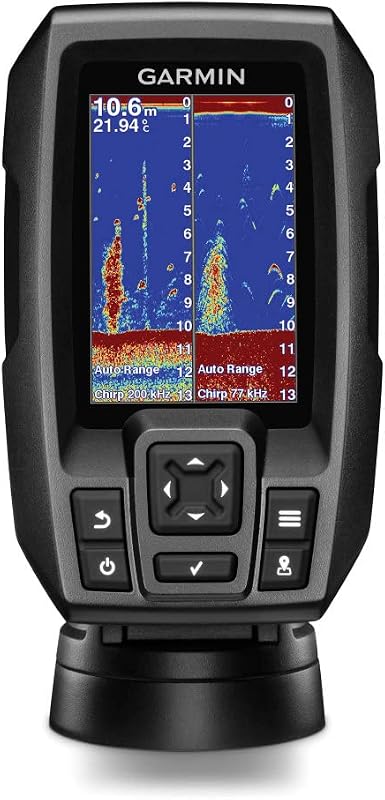
The best fish finder for most anglers shows depth, bottom, and fish clearly on a screen you can read in bright sun, and marks productive spots with GPS so you can find them again. Our pick is the Garmin Striker 4: Garmin lists a 3.5 in color display, a dual-beam CHIRP transducer, built-in GPS, and a flasher view, and the box includes transom and trolling motor mounts.
We compared seven units, from compact boat and kayak units to live sonar and two castables that stream to a phone. Every fish and depth finder here reads depth; the differences are screen size, sonar type, maps, and mounting.
This guide is general product information, not repair or electrical safety advice. Follow the installation, wiring, and charging instructions in your product’s manual, stop using any battery, charger, or electronics that overheat, swell, or smell of burning, and contact the manufacturer.
Our Top Picks at a Glance
- Best Overall: Garmin Striker 4. GPS, dual-beam CHIRP sonar, and boat mounts in the box, per Garmin.
- 2D Sonar With Preloaded Charts: Humminbird Helix 5 CHIRP GPS G3. The only unit here limited to 2D sonar that ships with a preloaded basemap (10,000+ lakes and U.S. coastlines, per the listing).
- Widest Included Chart Area: Lowrance Eagle 5 SplitShot HD. Inland and coastal charts for the U.S. and Canada per the listing; the other preloaded charts here are described as U.S. lakes or coastlines.
- Half-Foot Contour Mapping on a 5 in Screen: Lowrance HOOK Reveal 5 SplitShot. The only 5 in unit here whose listing names Genesis Live half-foot contour maps.
- Largest Screen, With Live Sonar: Lowrance Eagle Eye 9 Live. A 9 in display per the listing, versus 5 in on the next-largest screens here.
- Deeper-Reading Castable: Deeper PRO+ 2. Three beams and a 100 m depth range per Deeper, versus one beam and 50 m for the Deeper Start.
- Lightest Castable: Deeper Start. 0.07 kg (about 2.5 oz) versus 3.2 oz for the PRO+ 2 (both figures from Amazon listings).
Fish Finders Compared
G = Garmin, D = Deeper (maker page), H = Humminbird HELIX manual; L = Amazon listing. Scroll sideways on a phone to see every column.
| Model | Screen | Sonar | GPS and maps | Depth | Power |
|---|---|---|---|---|---|
| Garmin Striker 4 | 3.5 in, 480 x 320 pixels (G) | Traditional CHIRP, dual-beam transducer (G) | GPS, 5,000 waypoints (G); no charts listed | 1,600 ft fresh, 750 ft salt (L) | 10 to 20 V DC (G) |
| Humminbird Helix 5 CHIRP GPS G3 | 5 in, 800 x 480 pixels (H) | Dual Spectrum CHIRP, Wide and Narrow (L) | GPS, 10,000+ lake basemap, AutoChart Live (L) | Not listed | Not listed |
| Lowrance Eagle 5 SplitShot HD | 5 in IPS (L) | CHIRP plus DownScan (L) | C-MAP DISCOVER, U.S. and Canada (L) | 500 ft (L) | Not listed |
| Lowrance HOOK Reveal 5 SplitShot | 5 in SolarMAX (L) | CHIRP plus DownScan (L) | C-MAP, about 4,000 U.S. inland lakes, Genesis Live (L) | Not listed | 12 V DC (L) |
| Lowrance Eagle Eye 9 Live | 9 in IPS (L) | Live Forward, Live Down, CHIRP, DownScan (L) | C-MAP, 17,000+ U.S. lakes, Genesis Live (L) | 500 ft (L) | Not listed |
| Deeper PRO+ 2 | Your phone | Three beams, 7 to 47 degrees (D) | Built-in GPS and other satellite systems (D) | 15 cm to 100 m, about 330 ft (D) | Lithium-ion, up to 9 hr (D) |
| Deeper Start | Your phone | Single 40 degree beam (D) | GPS not listed (D) | 0.5 m to 50 m, about 165 ft (D) | Lithium polymer, up to 6 hr (D) |
How We Chose
We started with fish finders sold new on Amazon in the U.S. by established marine electronics makers. For each model we read the full Amazon listing and the maker’s page or manual where we could open it: Garmin’s and Deeper’s pages opened. For the Helix 5 we added Humminbird’s HELIX operations manual to its listing, and Humminbird lists the model among its current HELIX products. Lowrance’s site blocked our requests, so specs for the three Lowrance models come from their listings. Three of the seven listings had owner reviews we could use; a fourth covers several screen sizes, so we left its comments out. We weighed screen size and resolution, sonar type, GPS and charts, how the unit mounts or casts, and problems owners mention.
The order is editorial, not a sort by score. Best Overall goes to the Garmin Striker 4: it is the only unit here that clears the highest owner-rating bar in our published Best Overall criteria. The rest are grouped by type: mounted down-looking units first, then live sonar, then the two castables. A lower-ranked unit can show a higher AnglerTechLab Score. Three scores here include a 0.2 deduction for listing problems: the Striker 4’s listing describes a scanning sonar Garmin does not list for this model, the Eagle 5’s listing title covers screens from 4 to 9 in, so its ratings may include other Eagle sizes, and the Deeper PRO+ 2’s listing gives a display size for a sonar that uses your phone as its screen. Amazon owner ratings form the base of each score, with a limited editorial adjustment explained on our How We Review page; we do not run our own product trials. More sonar coverage is in our fish finders section.
We earn a commission from qualifying purchases made through links on this page. Commissions never affect our rankings or AnglerTechLab Scores.
The order of these products is explained in the article. The AnglerTechLab Score starts from Amazon customer ratings, with a limited editorial adjustment explained on our How We Review page.
| Award | Product | AnglerTechLab Score About AnglerTechLab ScoreThe AnglerTechLab Score is calculated with the published method on our How We Review page. Learn more › | |
|---|---|---|---|
 Garmin Striker 4 with Dual-Beam Transducer |
8.6/10 | Buy | |
 Humminbird Helix 5 CHIRP GPS G3 |
8.6/10 | Buy | |
 Lowrance Eagle 5 SplitShot HD with C-MAP Charts |
8.4/10 | Buy | |
 Lowrance HOOK Reveal 5 SplitShot |
8.1/10 | Buy | |
 Lowrance Eagle Eye 9 Live with C-MAP Charts |
8.8/10 | Buy | |
 Deeper PRO+ 2 Castable Sonar |
7.9/10 | Buy | |
 Deeper Start Castable Fish Finder |
8.0/10 | Buy |
Garmin Striker 4 with Dual-Beam Transducer
A compact 3.5 in GPS fishfinder sold with boat mounts. Garmin lists a 480 x 320 pixel color display, a CHIRP 77/200 kHz transducer, and a built-in flasher view for vertical jigging and ice fishing.
Pros
- Built-in GPS for marking waypoints
- Flasher view for stationary jigging, per Garmin
- Includes transom and trolling motor mounts
- Keyed button controls, per Garmin
Cons
- No battery, charger, or float in the box for ice use
- Small 3.5 in screen
- Garmin sells the portable kit for ice use separately
Humminbird Helix 5 CHIRP GPS G3
A GPS fishfinder and chartplotter with Dual Spectrum CHIRP sonar, according to the listing. The listing names a Humminbird Basemap of 10,000+ lakes and U.S. coastlines, AutoChart Live mapping, and an XNT 9 HW T transom transducer.
Pros
- Wide and Narrow CHIRP modes, per the listing
- Humminbird Basemap with lakes and coastlines, per the listing
- AutoChart Live maps depth, bottom hardness, and vegetation
- Keypad controls, per the listing
Cons
- No down or side imaging named in the listing
- 5 in screen, per Humminbird, smaller than the HELIX 7 models
Lowrance Eagle 5 SplitShot HD with C-MAP Charts
A 5 in IPS fish finder with a SplitShot HD transducer for CHIRP fish targets and DownScan views, according to the listing. An included C-MAP DISCOVER card covers inland and coastal waters across the U.S. and Canada.
Pros
- CHIRP and DownScan with FishReveal, per the listing
- Inland and coastal charts for the U.S. and Canada
- Twist-lock connector for fast installation and removal
- Auto-tuning sonar, per the listing
Cons
- Listing covers several sizes, so confirm the 5 in SplitShot HD
- The listing names no feature for recording your own contour maps
- Specs not confirmed on the maker's site
Lowrance HOOK Reveal 5 SplitShot
A 5 in fish finder with a SplitShot transducer that combines wide-angle high CHIRP and DownScan Imaging, according to the listing. It adds FishReveal, autotuning sonar, preloaded C-MAP maps for almost 4,000 U.S. inland lakes, and Genesis Live half-foot contour mapping.
Pros
- CHIRP and DownScan with FishReveal, per the listing
- Genesis Live creates half-foot contour maps
- Autotuning sonar adjusts settings for you
- SolarMAX display, per the listing
Cons
- The listing names no SideScan with the included transducer
- Preloaded maps listed for U.S. inland lakes
- Specs not confirmed on the maker's site
Lowrance Eagle Eye 9 Live with C-MAP Charts
A 9 in IPS fish finder with live sonar, according to the listing. One included transducer provides Live Forward, Live Down, CHIRP, and DownScan with FishReveal, and plugs into the display without a separate sonar module. C-MAP charts cover 17,000+ U.S. lakes.
Pros
- Live Forward and Live Down views, per the listing
- 9 in IPS display
- No separate sonar module to install
- Two-year warranty, per the listing
Cons
- Live sonar adds aiming and mounting decisions
- One owner wrote that the C-MAP charts "aren't the best or accurate"
- Specs not confirmed on the maker's site
Deeper PRO+ 2 Castable Sonar
A castable Wi-Fi sonar with built-in GPS that streams to the Fish Deeper app. Deeper lists three beams, a depth range to 100 m (about 330 ft), up to 9 hours per charge, and use as an ice fishing flasher for hole hopping.
Pros
- Three beams, from 7 to 47 degrees, per Deeper
- Depth range to about 330 ft, per Deeper
- Built-in GPS for mapping from shore
- Operating range down to -4°F, per Deeper
Cons
- Needs a phone as the screen
- Owners recommend a stout rod and heavy line for casting it
- App setup and pairing needed before first use
Deeper Start Castable Fish Finder
A castable Wi-Fi sonar that shows depth, bottom contour, and fish icons in the Fish Deeper app. Deeper lists a single 120 kHz, 40 degree beam, a depth range of 0.5 m to 50 m (about 165 ft), and up to 6 hours per charge.
Pros
- No wires or external batteries, per the listing
- Connection range of at least 50 m, per Deeper
- Charges in 2.5 hours, per Deeper
- Very light at 0.07 kg, per the listing
Cons
- Single beam only
- Deeper's operating range starts at 32°F
- GPS not listed by Deeper
Fish Finder Reviews
1. Garmin Striker 4 (Best Overall)
Who it’s for: Anglers on a small boat, jon boat, or kayak who want clear traditional sonar, GPS waypoints, and dedicated buttons, and who do not need structure imaging or charts.
Standout features: Garmin’s Striker 4 page lists keyed controls, 200 W (RMS) transmit power, an IPX7 water rating, and a head unit weight of 0.5 lb. The box holds the transducer with transom and trolling motor mounts, a tilt and swivel mount, and a power cable. Garmin also describes sonar history rewind, which lets you scroll back to mark a spot you passed, and a flasher view for stationary jigging.
- Pro: GPS waypoints and on-screen speed in a compact head unit.
- Pro: Mounts for both the transom and a trolling motor in the box.
- Con: The smallest built-in screen here, with no down imaging and no charts listed.
- Con: The listing’s first feature line describes ClearVü scanning sonar, which Garmin does not list for this model.
What owners say: Owners on this listing mention seeing depth, water temperature, speed, and battery voltage on one screen, and two say the head unit clicks in and out of its bracket or is easy to remove and store. One owner mounted the transducer on a trolling motor instead of drilling the hull and could read the screen in full sun with sunglasses on, but found the power leads thin and had to secure them; that owner also says the reading cuts out at higher speeds, while another reports depth readings at high speed. One owner’s first unit had power problems, and Garmin exchanged it after troubleshooting.
Who should look elsewhere: For structure images, choose a Lowrance with DownScan; for lake charts, the Helix 5 or a Lowrance. For a kayak without a battery, Garmin sells a portable kit with battery and charger that it calls “perfect for kayak, canoe or ice fishing.”
2. Humminbird Helix 5 CHIRP GPS G3 (2D Sonar With Preloaded Charts)
Who it’s for: Anglers who fish several lakes or the coast and want charts from the first trip.
Standout features: According to the Amazon listing, the Dual Spectrum CHIRP sonar has a Wide mode for coverage and a Narrow mode for detail. The Humminbird Basemap covers the continental U.S. coastline as well as lakes, and the unit accepts LakeMaster, CoastMaster, and Navionics charts. AutoChart Live records depth contours, bottom hardness, and vegetation, with eight hours of built-in recording. It ships with an XNT 9 HW T transom transducer.
- Pro: Accepts three premium chart brands, per the listing.
- Pro: Maps bottom hardness and vegetation, not just depth.
- Con: The listing describes 2D sonar only, with no down or side imaging.
- Con: Specs could not be confirmed with the maker.
Who should look elsewhere: For structure images, the Eagle 5 and HOOK Reveal 5 add DownScan. Our Humminbird Helix 5 review covers this unit’s mapping in more detail.
3. Lowrance Eagle 5 SplitShot HD (Widest Included Chart Area)
Who it’s for: Small-boat and kayak anglers who fish inland and coastal water in the U.S. or Canada and want DownScan on a 5 in screen.
Standout features: This listing covers several Eagle sizes; the version here is the Eagle 5 SplitShot HD with C-MAP charts for the U.S. and Canada, per its model name. Because the listing’s ratings may cover other sizes, its AnglerTechLab Score carries a 0.2 deduction. According to the listing, it pairs the 5 in IPS display with a SplitShot HD transducer for CHIRP fish targets and DownScan structure views, plus FishReveal and auto-tuning sonar.
- Pro: DownScan and FishReveal on an IPS screen, per the listing.
- Pro: Twist-lock connector for fast installation and removal, per the listing.
- Con: The listing covers several sizes and transducers, so confirm you are ordering the 5 in SplitShot HD.
- Con: The listing names no feature for recording your own contour maps.
Who should look elsewhere: To record your own contours on a 5 in screen, the HOOK Reveal 5 listing names Genesis Live; for maker-confirmed specs, the Striker 4 is the safer pick.
4. Lowrance HOOK Reveal 5 SplitShot (Half-Foot Contour Mapping on a 5 in Screen)
Who it’s for: Anglers on smaller inland lakes who want DownScan structure views and detailed contour maps they record themselves.
Standout features: According to the Amazon listing, the SplitShot transducer combines wide-angle high CHIRP with DownScan Imaging, and FishReveal combines CHIRP fish targets with the DownScan view. Genesis Live builds half-foot contour maps and saves them to a blank microSD card. The listing’s general description mentions SideScan but ties it to the TripleShot transducer version.
- Pro: Autotuning sonar means fewer settings to adjust on the water.
- Pro: Preloaded C-MAP inland lake maps plus your own contours.
- Con: The listing names no SideScan with the included SplitShot transducer.
- Con: Specs could not be confirmed with the maker.
Who should look elsewhere: If you fish coastal or Canadian water, the Eagle 5’s included card covers both, per its listing. Our Lowrance HOOK Reveal 5 review covers this unit on its own.
5. Lowrance Eagle Eye 9 Live (Largest Screen, With Live Sonar)
Who it’s for: Anglers who want to watch fish react to a lure in real time and have room for a 9 in display.
Standout features: According to the Amazon listing, one included transducer delivers Live Forward, Live Down, CHIRP sonar, and DownScan with FishReveal, and it plugs straight into the display without a separate sonar module.
- Pro: Live views show fish and your lure moving ahead of or below the boat.
- Pro: C-MAP coverage of more than 17,000 U.S. lakes, per the listing; check that your lakes are included.
- Con: Live sonar adds aiming and mounting decisions a down-looking unit does not need.
- Con: Specs could not be confirmed with the maker.
What owners say: One owner watched live bait and sinkers in about 40 ft of river water while fishing for flathead catfish. Another prefers the forward view to the down view and said the C-MAP charts “aren’t the best or accurate,” adding that they use it for forward sonar, not mapping. Two owners place it a step below higher-end live sonar, one calling it a great entry-level unit and the other, who uses it on the ice, closer to a fancy ice fishing flasher. One owner dislikes the trolling motor mount in wind.
Who should look elsewhere: If your console has room only for a small display, or you mainly need depth and fish arches, the Striker 4 covers that.
6. Deeper PRO+ 2 (Deeper-Reading Castable)
Who it’s for: Bank, dock, and kayak anglers who want a shore fishing fish finder that maps the bottom and keeps working in winter.
Standout features: Deeper’s product page lists beams of 675 kHz at 7 degrees, 240 kHz at 20 degrees, and 100 kHz at 47 degrees, its own Wi-Fi with a stable connection up to 100 m, and GPS, GLONASS, Galileo, BeiDou, and QZSS positioning. Deeper lists a charge to 80% in 45 minutes and an operating range from -4°F to 104°F. Per the Amazon listing, it builds bathymetric maps from shore. The same listing gives a 2.4 in display size, but the sonar has no screen of its own, so its AnglerTechLab Score carries a 0.2 deduction.
- Pro: Twice the depth range Deeper lists for the Start, with three beams instead of one.
- Pro: Built-in positioning for maps made from the bank.
- Con: Your phone is the screen, so it has to stay charged and in range.
- Con: Heavier than the Start, per the listings.
What owners say: Several owners call it easy to use once it is set up, and one who has used it for two years from the bank and on the ice praises the connection range. Two recommend a dedicated, stout rod and heavy line for casting it. One kayak owner reports occasional dropped connections and cloud uploads that take several attempts, and says paddle strokes can show up as false fish. Another owner’s unit stopped charging and lost its Wi-Fi signal twice: the company replaced it the first time under warranty, and the second failure came after the warranty ended.
Who should look elsewhere: Boat anglers will find a mounted screen easier to read at a glance.
7. Deeper Start (Lightest Castable)
Who it’s for: Casual bank, dock, and pier anglers who want depth, bottom contour, and fish icons on a phone without wiring anything.
Standout features: Deeper’s Start page lists a 120 kHz beam, 10 scans per second, a Wi-Fi range of at least 50 m depending on your phone, a 2.5 hour charge time, and an operating range of 32°F to 104°F. Per the Amazon listing, it saves each scan with time and location for later review.
- Pro: No wires or external batteries, per the listing.
- Pro: Charges in 2.5 hours, per Deeper.
- Con: One wide beam and half the PRO+ 2’s depth range.
- Con: Deeper’s operating range starts at 32°F, so Deeper does not rate it for freezing temperatures.
Who should look elsewhere: To map from shore, fish below freezing, or read deeper water, choose the PRO+ 2.
How to Choose the Best Fish Finder
Screen Size and Resolution
A 3.5 in screen like the Striker 4’s fits a kayak rail or jon boat console; a 5 in display gives each pane more room when you split sonar and map, and a 9 in screen suits a bass boat. Size is not the whole story, because pixel count decides how fine the detail looks. Garmin lists 480 x 320 pixels for the Striker 4, and Humminbird’s HELIX manual lists 800 x 480 for the Helix 5; the Lowrance listings here give no pixel count, so check it on the maker’s spec page before you buy.
Sonar Type: Traditional CHIRP, Down Imaging, or Live
The best fish sonar for you depends on what you want to see under the boat. Among the mounted units, the Striker 4 and Helix 5 are limited to traditional CHIRP and show fish as arches over a bottom line, the easiest view to learn. The three Lowrance units add a down-imaging view on top of CHIRP, called DownScan, which draws brush and rock as a picture. Live sonar on the Eagle Eye 9 shows fish and your lure moving in real time. If you have already settled on Lowrance, our breakdown of the Lowrance lineup compares the HOOK Reveal, Eagle, Eagle Eye, and Elite FS families.
GPS, Charts, and Maps You Record
GPS lets you mark a brush pile or drop-off and drive back to it. Beyond that, decide between preloaded charts, which the Helix 5 and the three Lowrance units include, and contour maps you record yourself, which suit small lakes you fish often.
Mounted Unit or Castable Sonar
The best fish finder for boat use is usually a mounted unit, since a boat has room for a battery and a permanent transducer mount. A mounted unit needs a 12 V power source within its listed voltage range, a transducer on the transom or trolling motor, and a cable run to the display; follow the fuse and wiring steps in your manual. A castable fish sonar needs none of that: clip it to your line, cast, and read your phone. The trade-offs are depth range, the phone itself, and cold: Deeper rates the Start to 32°F and the PRO+ 2 to -4°F.
Frequently Asked Questions
How does a fish finder work?
A transducer sends sound pulses into the water and listens for echoes, and the unit times each echo to work out depth and draw the bottom, structure, and fish. Garmin explains that CHIRP sends “a continuous sweep of frequencies” instead of a single frequency, which it says produces crisper fish arches and better target separation.
How do you read a fish finder?
On a standard 2D screen, the top edge is the surface, the newest readings appear on the right and scroll left, and the bright continuous line is the bottom. A fish passing through the cone shows as an arch, because its distance to the transducer shrinks and then grows; half arches are usually fish at the edge of the beam.
What is the difference between a fish finder and depth finder?
A basic depth finder may show only a number. A fish finder and depth finder in one, which is what every unit here is, also draws the bottom, structure, and fish.
Do you need GPS on a fish finder?
Not to find fish, but GPS lets you save a spot, return to it, and show trolling speed. The Lowrance listings do not give a separate GPS line, so confirm GPS on the maker’s page before you buy. If charts and waypoints are your priority, our GPS fish finder combo picks compare units built around them.
Can you use a fish finder from shore or a kayak?
From shore, a castable like the Deeper PRO+ 2 or Start is the practical option. A compact mounted unit works on a kayak with a 12 V battery and a transducer mount; follow the maker’s mounting and wiring instructions.
Can you use a regular fish finder for ice fishing?
Some can: Garmin says the Striker 4’s flasher suits “stationary fishing, such as ice fishing,” though you need portable power and a way to hang the transducer. Our roundup of fish finders built for ice fishing covers ice kits and cold-weather battery limits, and helps if you are deciding between a flasher and an LCD.
About the author

Mason McKinney enjoys fishing Minnesota's lakes for crappie, walleye, and other freshwater species. He uses forward-facing sonar, GPS fish finders, and spot-lock trolling motors to locate fish around underwater structures and maintain precise boat positioning.