
Newport Trolling Motor Review: Kayak Series 36 lb and 55 lb
Our Newport trolling motor review compares the Kayak Series 36 lb and 55 lb and explains when Newport's NV, X, or L Series fits your boat better.
 Updated November 3, 2026
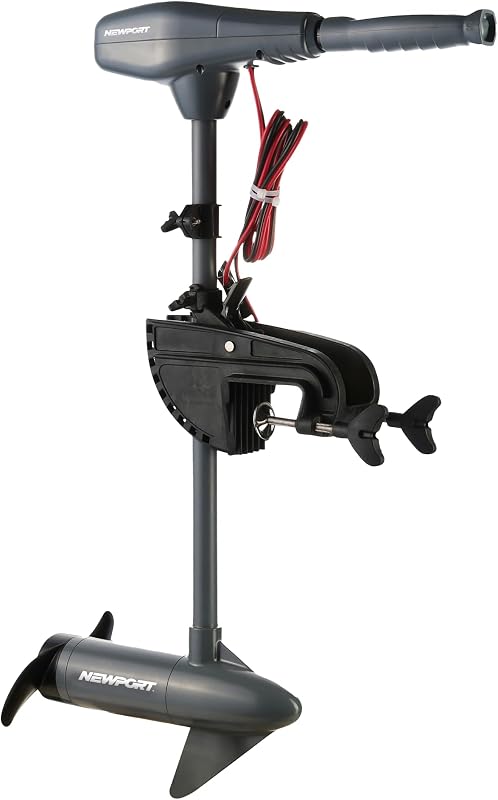
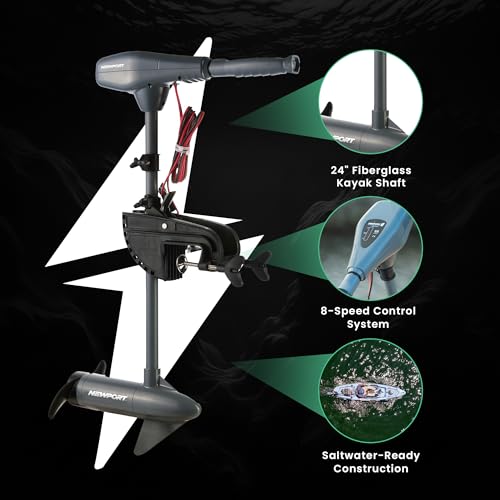
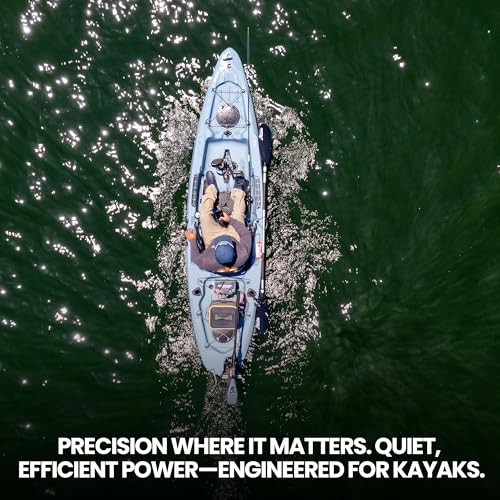
This Newport trolling motor review covers the Kayak Series, the transom-mount electric motor Newport Vessels sizes for kayaks and canoes, in its two versions: 36 lb and 55 lb of thrust, both on a 24 in shaft and both rated for saltwater and freshwater. It is a simple tiller motor. You steer with a telescoping handle and twist it to pick one of five forward or three reverse speeds. It fits kayak and canoe anglers who have a transom or a motor mount and can carry a 12 V deep cycle battery. If your boat sits higher off the water, Newport’s NV, X, and L Series use longer shafts, and we explain below which line fits which boat.
This review is research-based: Newport’s product pages, manual, and guides, plus both Amazon listings and their owner reviews. We point out where a listing and Newport disagree.
This guide is general product information, not repair or electrical safety advice. Follow the installation, wiring, and charging instructions in your product’s manual, stop using any battery, charger, or electronics that overheat, swell, or smell of burning, and contact the manufacturer.
We earn a commission from qualifying purchases made through links on this page. Commissions never affect our rankings or AnglerTechLab Scores.

Newport Kayak Series 36-Pound Thrust Transom Trolling Motor (24 in Shaft)




As an Amazon Associate I earn from qualifying purchases.
Newport Kayak Series 55-Pound Thrust Transom Trolling Motor (24 in Shaft)

As an Amazon Associate I earn from qualifying purchases.
Newport Trolling Motor Specs: Kayak Series at a Glance
Sources: Newport’s Kayak Series product page (N), the Kayak Series owner’s manual (M), and the two Amazon listings (L).
| Spec | Kayak Series 36 lb | Kayak Series 55 lb |
|---|---|---|
| Thrust | 36 lb (N, M) | 55 lb (N, M) |
| Input | 12 V DC, 29 A max, 348 W (M) | 12 V DC, 52 A max, 624 W (M) |
| Horsepower equivalent | 0.48 HP (N); the listing says 0.83 hp | 0.83 HP (N, L) |
| Weight | 18 lb (N); the listing says 20 pounds | 23 lb (N, L) |
| Propeller | 2-blade, small (N) | 3-blade, large (N) |
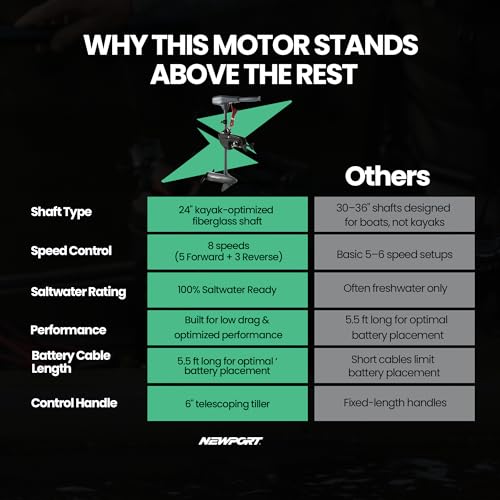
| Shaft | 24 in, height adjustable (N, L) | |
| Speeds and control | 5 forward, 3 reverse; 6 in telescoping handle (N) | |
| Battery cables | 5 ft 6 in (N, L) | |
| In the box | Motor, propeller and hardware, circuit breaker (N); battery not included (M, L); no kayak mount listed in the box (N, L) | |
| Motor and meter | Brushed motor; 5-point LED battery meter (N) | |
| Water | Saltwater and freshwater (N) | |
| Operating temperature | -4°F to 113°F (M) | |
| Warranty | 2-year limited (N) | |
What We Like
- Sized for small craft. Newport sizes the 24 in shaft for kayaks and canoes, and the 5 ft 6 in cables let you place the battery where it best balances the boat.
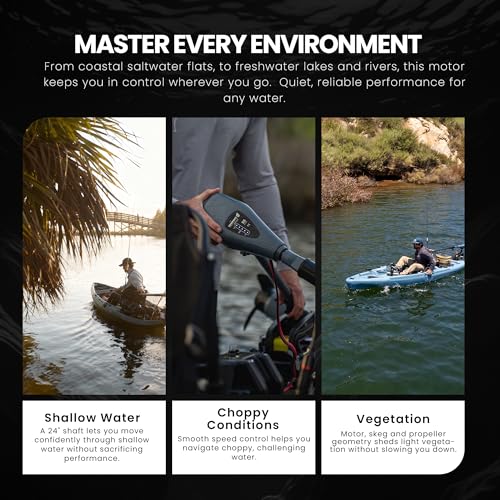
- Saltwater rated. Newport lists both versions for saltwater and freshwater, and one 36 lb owner runs it in the Pacific from a large fishing kayak with no problems so far.
- Breaker in the box, per Newport. Newport’s page lists a circuit breaker with each version. The 36 lb Amazon listing does not name one in its contents, so check what ships.
- Quiet. Owners of both versions describe it as quiet.
What Could Be Better
- Low speed can be too fast. Two 36 lb owners say the lowest setting is faster than they want for trolling.
- Weight on a kayak. Newport lists 18 lb and 23 lb, and three 36 lb owners call it heavy.
- Battery meter limits. The manual says the LED meter is designed for 12 V deep cycle batteries, not lithium, and that its reading cannot be trusted on a lithium battery. One 36 lb owner uses the lithium battery’s own gauge instead.
- Listing error. The 36 lb listing gives the 55 lb model’s horsepower figure.
- Mount not included. It uses a standard transom clamp, per Newport, so a kayak without a transom needs a separate motor mount.
Which Newport Line Fits Your Boat
Newport sells four transom-mount tiller lines, all listed with brushed motor designs, five forward and three reverse speeds, and saltwater and freshwater use, per the product pages for the NV Series, X Series, and L Series. The real differences are shaft length, thrust, and voltage.
| Line | Thrust options | Shaft | Voltage | Notes, per Newport |
|---|---|---|---|---|
| Kayak Series | 36, 55 lb | 24 in | 12 V | Kayaks, canoes, and pedal boats |
| NV Series | 36, 46, 55, 62, 86 lb | 30 in (36 to 55 lb); 36 in (62 and 86 lb) | 12 V; 24 V for 86 lb | Lakes, rivers, bays, and coastal waters |
| X Series | 55 lb | 36 in | 12 V | 6 in telescoping handle that also tilts 30 degrees |
| L Series | 62, 86 lb | 40 in | 12 V (62 lb); 24 V (86 lb) | Larger boats and deeper transoms |
Start with shaft length. Newport’s shaft length guide says to measure from the mounting spot on the transom down to the waterline and add 20 in, to add another 5 in if you often run in rough water, and to pick the longer size when you fall between two. Worked backward, the Kayak Series’ 24 in shaft suits a mount about 4 in above the water. The NV Series’ 30 in and 36 in shafts suit mounts about 10 in and 16 in up, and the L Series’ 40 in shaft suits a mount about 20 in up. For more on measuring shaft length, see our separate guide.
Then check thrust. Newport’s thrust guide gives a rule of thumb for slow fishing use, not for a primary motor: 5 lb of thrust for every 200 lb of boat weight plus the boat’s maximum load capacity, with more thrust for chop, current, tide, wind, or fast runs between spots. By that rule, 36 lb covers about 1,440 lb of boat and load and 55 lb about 2,200 lb. Newport’s trolling motor collection page adds a rough guide by length for boats in general, not kayaks: 36 to 46 lb for boats up to 12 ft, 55 lb for 12 to 16 ft, and 62 or 86 lb for 16 ft and up. For a fuller walk-through of how much thrust a boat needs, see our sizing guide.
Voltage last. Every Newport version runs on 12 V except the 86 lb versions, which Newport says need a 24 V system.
36 lb or 55 lb: Choosing a Newport Vessels Kayak Series Trolling Motor
The two versions differ in thrust, current draw, weight, and propeller. Per the manual, the 55 lb draws up to 52 A at full power against 29 A for the 36 lb, so it drains the same battery faster when run wide open. Per Newport, it also weighs 5 lb more and turns a larger 3-blade propeller.
Choose the 36 lb for a light sit-on-top or a solo canoe on calm water, when weight and run time matter more than speed.
Choose the 55 lb for a heavier load: a tandem kayak, a big fishing kayak with a lot of gear, or water with chop, wind, or current. One 55 lb owner ran a 14 ft tandem kayak, with one adult and a heavy battery aboard, through a choppy bay, and another says it has plenty of power for going upriver. Newport gives no boat size or weight limit for the Kayak Series itself; the length guide above covers boats in general.
Speed and Run Time
Newport does not list a top speed in its specifications or manual; the manual says speed depends on load, water conditions, hull type, and wind. The Kayak Series product page does have a Motor Range Estimator that models run time and range by speed for a 12 V AGM battery on kayaks of two lengths. These are modeled figures, not measurements, and the range and run time columns show the same number at every speed, so we do not reproduce them. Its kayak figures stop at 3 mph for the 36 lb and at 4 mph for the 55 lb.
Owner reports are close to those ceilings. On the 55 lb listing, one owner reports 4.5 mph at full speed, and another estimates about 4 mph on the fifth setting in chop. On the 36 lb listing, one owner got 3.8 mph on a Bonafide SS10.7, no faster than the 24 lb Watersnake it replaced, and sent it back. Another reports 6 to 7 mph on a Lifetime kayak “with a bit of modifications,” a figure well above every other report.
Run time depends on the battery and on how hard you push; the manual says a larger capacity battery extends it. A 36 lb owner ran it more than three and a half hours, mostly at low speed, and used about a quarter of a lithium battery’s charge by that battery’s own gauge. On the 55 lb listing, one owner with a large deep cycle battery trolls for hours on speeds 1 to 3 but says range drops considerably at 4 and 5, and another ran out of power in about an hour at full speed.
Battery, Wiring, and Saltwater Care
The Kayak Series owner’s manual recommends a 12 V deep cycle or marine battery and a manual reset circuit breaker in the motor leads close to the battery, and it gives a wire size to use if you extend the supplied cable. It warns that a charging battery gives off gases that a spark can ignite, so switches must be off before you connect, and the speed control should sit at neutral. It also says to disconnect the battery when you work on the propeller or stop using the motor, and not to modify the unit. Leave any wiring beyond the manual’s steps to a qualified marine technician.
Newport’s Kayak Series page says its motors are “saltwater compatible, but they are not corrosion-proof,” that they should be washed with fresh water and dried after saltwater use, and never stored in salt water. The manual adds that you should rinse only the parts that touched salt water and keep the top cover dry. Using a freshwater motor in salt water is a different question, covered separately.
Mounting It on a Kayak or Canoe
Owners on the 55 lb listing used a mount made for a Lifetime kayak and a 2×4 side mount that kept the motor clamped through three capsizes. On the 36 lb listing, owners used a universal kayak mount and a side mount; the side mount user says the motor tilts the kayak slightly. One 36 lb owner found it very hard to fit through the pedal drive slot of a Bonafide SS10.7. Per the manual, set the depth collar so the propeller blades sit 6 to 12 in below the surface, and do not over tighten the bracket on the fiberglass shaft. Our guide to installing a trolling motor on a kayak covers mount options in more detail.
What Owners Say
55 lb. One owner says it outperforms the Minn Kota it replaced on the same kayak, with higher speed and less battery drain. One calls it quite heavy but reads that as solid, while another found it light enough to cause no trouble righting the kayak after a capsize. One reports that the tilt button is not as robust as it should be. Another says reverse stopped working after four outings and that Newport handled the warranty claim fully; a second owner says Newport’s tech support answered a question quickly. One review on this listing describes heavily modifying what the reviewer calls an NV Series motor, so we left it out.
36 lb. One owner likes the short shaft, another the extendable handle and long battery cable, and a third calls it smooth and quiet. One calls it lightweight on a 10 ft kayak, against the three who call it heavy.
How It Compares
Newport NV Series. Newport describes the Kayak Series as an update to the NV Series, sized for kayaks and canoes. Choose an NV, with its 30 in or 36 in shaft, if your mount sits too high for a 24 in shaft to put the propeller 6 to 12 in under the surface.
Minn Kota Endura C2 30. The Endura C2 30 Amazon listing gives 30 lb of thrust, a 30 in shaft, a 17-pound item weight, a 6 in telescoping tiller with five forward and three reverse speeds, and freshwater use in its title. The Kayak Series 36 lb has more thrust, a shorter shaft for a low kayak mount, and a saltwater rating; Newport lists it at 18 lb. Our Minn Kota Endura review covers that motor in full, and our trolling motors section lists more options.
Who Should Look Elsewhere
- You want hands-free boat control. Every line here is hand-steered; for GPS anchoring or foot pedal or remote steering, look at bow-mount motors.
- You want a kayak motor as your main propulsion. Newport’s own comparison lists the Kayak Series as secondary propulsion and its NK180PRO and NK300 outboard kayak motors as primary propulsion, so for a Newport kayak motor that moves the boat on its own, look at those.
- You want a brushless motor. Newport lists all four tiller lines as brushed motors; the brushless motors in its kayak comparison are the NK outboard kayak motors, a different class.
- You need a very slow troll on a light kayak. One 36 lb owner reports 2 to 3 mph on the lowest setting, and another wishes it ran at half its lowest speed.
- You use a pedal drive kayak. Measure the drive slot first; one 36 lb owner could barely fit the motor through it.
Why You Should Trust Us
We do not conduct our own product trials. This review draws on the Newport pages, manual, and guides linked above, the two Kayak Series Amazon listings and their owner reviews, and the Endura C2 30 listing. Both Kayak Series listings name Torero Imports LLC in the manufacturer field; Newport’s website is run by Torero Specialty Products LLC and/or its affiliates, per its terms of service. The AnglerTechLab Score starts from Amazon owner ratings, with a limited editorial adjustment when a listing conflicts with the maker’s published specifications. The 36 lb score includes a 0.2-point deduction for that reason: its listing gives the horsepower figure Newport lists for the 55 lb version. Commissions never affect our recommendations or scores. The full method is on our How We Review page.
Final Verdict
The Newport Kayak Series is a saltwater-rated tiller motor sized for kayaks and canoes, with a breaker in the box per Newport. Pick the 36 lb for a light solo kayak and the 55 lb for a tandem, a bigger fishing kayak, or wind and chop. If your mount sits higher, choose an NV, X, or L Series by shaft length. Budget for a 12 V deep cycle battery and, without a transom, a motor mount.
Frequently Asked Questions
How fast will a Newport trolling motor go?
Newport lists no top speed in its specifications or manual. Its online estimator models the Kayak Series on kayaks up to 3 mph for the 36 lb and 4 mph for the 55 lb, and most owner reports fall between about 3.8 and 4.5 mph; one owner reports more after modifying the setup.
How long will a Newport Vessels trolling motor run on one battery?
It depends on battery capacity and speed. Newport’s Kayak Series page has an estimator for run time by speed, and owners report several hours at low speed and as little as about an hour wide open on the 55 lb.
What battery does a Newport Vessels electric trolling motor need?
One 12 V deep cycle or marine battery, not included, for every version up to 62 lb; the 86 lb versions need 24 V. The Kayak Series meter is not designed for lithium batteries, per the manual.
Can you use a Newport trolling motor in salt water?
Yes, per Newport, but the motors are not corrosion-proof: rinse with fresh water after each saltwater trip and never store the motor in the water.
Is the Newport Vessels 55lb trolling motor too much for a kayak?
Owners report using it on kayaks, including a 14 ft tandem, and no owner on that listing says it is too powerful, though some call it heavy. On a light solo kayak on calm water, the lighter 36 lb may be enough.
About the author

Brent Curtis enjoys chasing largemouth bass on Alabama lakes, especially around submerged structures and weed beds. He uses side-imaging fish finders and GPS trolling motors to locate fish, hold his boat in position, and explore productive fishing spots.