
Best 12 Volt Trolling Motor: 6 Transom Tillers Compared
Six 12-volt transom mount trolling motors from Newport and Minn Kota, compared on thrust, shaft length for your transom, amp draw, and saltwater care.
 Updated November 3, 2026

A 12 volt trolling motor runs from a single 12-volt battery, which keeps the setup simple enough for a kayak, canoe, jon boat, or small aluminum boat. Our top pick is the Newport NV-Series 46 lb: Newport’s NV Series owner’s manual rates it at 12 V with a 40 A maximum draw, and Newport pairs it with a 30 in shaft, five forward and three reverse speeds, and a build it lists for both saltwater and freshwater. We compared six 12-volt transom mount trolling motors from Newport and Minn Kota, from 30 lb to 62 lb of thrust, and four of them are listed by Newport for salt water.
This guide is general product information, not repair or electrical safety advice. Follow the installation, wiring, and charging instructions in your product’s manual, stop using any battery, charger, or electronics that overheat, swell, or smell of burning, and contact the manufacturer.
Our Top Picks at a Glance
- Best Overall: Newport NV-Series 46 lb. Rated 12 V with a 40 A maximum draw and a 30 in shaft, per Newport.
- Best Low-Thrust Option: Minn Kota Endura C2 30. At 30 lb, the least thrust in this group, on a 30 in shaft (per the listing).
- Best Step-Up From the C2 30: Minn Kota Endura C2 40. 40 lb on a 36 in shaft, versus 30 lb on a 30 in shaft for the C2 30 (both per the listings).
- Best for Kayaks and Canoes: Newport Kayak Series 55 lb. The shortest shaft here at 24 in, from a series Newport designs for kayaks, canoes, and pedal boats.
- Best 55 lb Option for Taller Transoms: Newport X-Series 55 lb. The same 55 lb and 52 A maximum draw as the Kayak Series, on a 36 in shaft with a handle that tilts 30 degrees, per Newport.
- Most Thrust in This Group: Newport L-Series 62 lb. 62 lb is the highest thrust of the six and the most Newport offers on 12 V; its 40 in shaft is also the longest here.
12 Volt Trolling Motors Compared
All six run on one 12-volt battery, and all list five forward and three reverse speeds except the Endura C2 40, whose listing gives both five and six forward; Minn Kota lists five for the Endura line. N = Newport product page or owner’s manual; L = Amazon listing. Scroll sideways on a phone to see every column.
| Model | Thrust | Shaft | Maximum draw at 12 V | Battery meter | Source |
|---|---|---|---|---|---|
| Newport NV-Series 46 lb | 46 lb | 30 in | 40 A (480 W) | 5 LEDs | N (NV Series page and manual) |
| Minn Kota Endura C2 30 | 30 lb | 30 in | Not listed | Not listed | L |
| Minn Kota Endura C2 40 | 40 lb | 36 in | Not listed | Not listed | L |
| Newport Kayak Series 55 lb | 55 lb | 24 in | 52 A (624 W) | 5 LEDs | N (Kayak Series page and manual) |
| Newport X-Series 55 lb | 55 lb | 36 in | 52 A (624 W) | 10 LEDs | N (X Series page and manual) |
| Newport L-Series 62 lb | 62 lb | 40 in | Not confirmed (Newport’s page and manual differ) | Not confirmed (Newport’s page and manual differ) | N (L Series page and manual) |
How We Chose
We started with trolling motors sold new on Amazon in the U.S. and kept only models with solid owner ratings from enough buyers, a manufacturer field that matches the brand or its confirmed parent company, and 12-volt operation stated in the listing or on the maker’s page. Among the brands we found, only Newport and Minn Kota had listings that met all of those requirements and were 12-volt transom motors. Because the field is this narrow, four of the six picks are Newport models, the most we allow from one brand in this category. This roundup covers hand-steered transom motors; bow-mount motors are outside its scope.
For the four Newport motors we read each product page and owner’s manual on newportvessels.com, and their specs here come from those documents unless marked otherwise. Minn Kota’s Endura specifications page confirms the line’s sizes, 12-volt operation, and speed steps, but neither listing’s part number appears in Minn Kota’s current item table, so we could not confirm that these two exact models are still in production, and they are not eligible for Best Overall. Five of the six listings had owner reviews we could read. We weighed 12-volt operation, thrust, shaft length, current draw, the battery meter, and owner-reported problems.
Best Overall goes to the NV-Series 46 lb because it meets our published Best Overall criteria best among the models whose production status we could confirm with the maker. The rest run from least to most thrust, 30 lb to 62 lb, so you can find the step that fits your boat; the order is editorial, not a sort by score. Each AnglerTechLab Score starts from Amazon owner ratings, with a limited editorial adjustment explained on our How We Review page; we do not run our own product trials. More motor coverage is in our trolling motors section.
We earn a commission from qualifying purchases made through links on this page. Commissions never affect our rankings or AnglerTechLab Scores.
The order of these products is explained in the article. The AnglerTechLab Score starts from Amazon customer ratings, with a limited editorial adjustment explained on our How We Review page.
| Award | Product | AnglerTechLab Score About AnglerTechLab ScoreThe AnglerTechLab Score is calculated with the published method on our How We Review page. Learn more › | |
|---|---|---|---|
 Newport NV-Series 46-Pound Thrust Transom Trolling Motor (30 in Shaft) |
8.8/10 | Buy | |
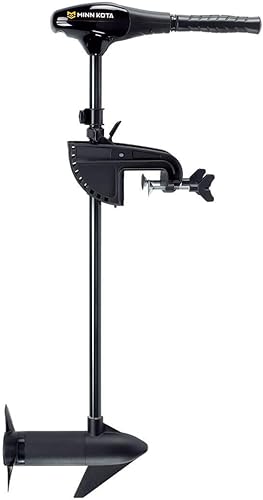 Minn Kota Endura C2 30 Transom Trolling Motor (30 in Shaft) |
8.8/10 | Buy | |
|
Minn Kota Endura C2 40 Transom Trolling Motor (36 in Shaft)
|
8.8/10 | Buy | |
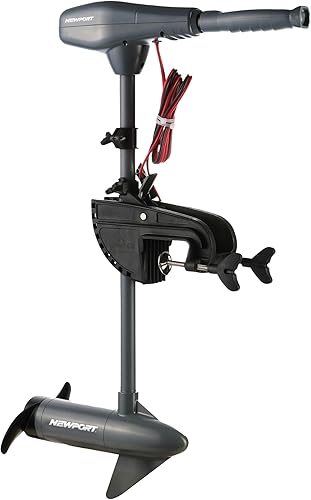 Newport Kayak Series 55-Pound Thrust Transom Trolling Motor (24 in Shaft) |
8.8/10 | Buy | |
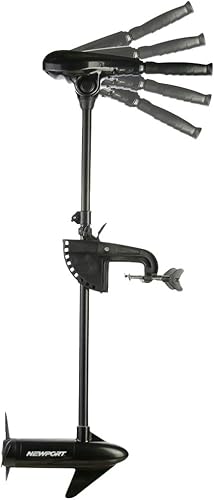 Newport X-Series 55-Pound Thrust Transom Trolling Motor (36 in Shaft) |
8.4/10 | Buy | |
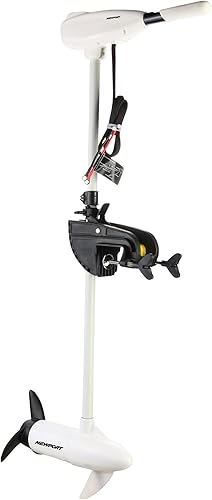 Newport L-Series 62-Pound Thrust Transom Trolling Motor (40 in Shaft) |
8.4/10 | Buy |
Newport NV-Series 46-Pound Thrust Transom Trolling Motor (30 in Shaft)
A 12-volt tiller motor compatible with saltwater and freshwater, with 46 lb of thrust, a 30 in shaft, 5 forward and 3 reverse speeds, and a 3-blade propeller. Newport lists 20 lb and a 40 A maximum draw. Battery not included.
Pros
- Compatible with saltwater and freshwater, per Newport
- 40 A maximum draw, per Newport
- 5-point LED battery meter, per Newport
- Runs on a single 12 V battery, per Newport
Cons
- Five fixed forward speeds rather than variable speed
- Tiller steering; Newport's page lists no remote or position hold
- Less thrust than Newport's 55 lb models for wind or heavier loads
Minn Kota Endura C2 30 Transom Trolling Motor (30 in Shaft)
A 12-volt, tiller-steer transom motor that its listing title calls freshwater. According to the listing, it has 30 lb of thrust, a 30 in composite shaft, a 6-inch telescoping tiller, five forward and three reverse speeds, and a 10-position lever lock bracket.
Pros
- 15 lb item weight, per the listing
- Five forward and three reverse speeds on a telescoping tiller, per the listing
- 10-position lever lock bracket for setting the motor angle, per the listing
- Several owners describe it as quiet
Cons
- Listing title says freshwater only
- No battery meter named in the listing
- Three owners say reverse is weak
- Part number not in Minn Kota's current item table, so production status is unconfirmed
Minn Kota Endura C2 40 Transom Trolling Motor (36 in Shaft)
A 12-volt, tiller-steer transom motor that its listing title calls freshwater. According to the listing, it has 40 lb of thrust, a 36 in composite shaft, a 6-inch telescoping tiller, and a 10-position lever lock bracket.
Pros
- 36 in shaft for taller transoms than the 30 in Endura C2 30
- Six-inch telescoping tiller, per the listing
- 10-position lever lock bracket, per the listing
- Owners report it moving 12 ft boats with two or three adults
Cons
- Listing gives both five and six forward speeds
- Listing weight and engine type fields are not usable
- Listing title says freshwater only
- One owner found the throttle settings touchy
Newport Kayak Series 55-Pound Thrust Transom Trolling Motor (24 in Shaft)
A saltwater-compatible tiller motor for kayaks and canoes with 55 lb of thrust, a 24 in adjustable shaft, 5 forward and 3 reverse speeds, and a 3-blade propeller. Newport lists 23 lb and a 52 A maximum draw. Battery and kayak mount not included.
Pros
- 55 lb of thrust in a motor Newport sizes for kayaks and canoes
- Compatible with saltwater and freshwater, per Newport
- Circuit breaker included, per Newport
- 5 ft 6 in battery cables for flexible battery placement
Cons
- Lists a 52 A maximum draw, per the manual
- Tiller steering only; the listing mentions no remote or GPS
- Built-in meter is not designed for lithium batteries, per the manual
- Needs a separate motor mount on kayaks without a transom
Newport X-Series 55-Pound Thrust Transom Trolling Motor (36 in Shaft)
A saltwater-compatible, 12 V tiller motor with 55 lb of thrust and a 36 in shaft. Newport lists a 6 in telescoping handle that tilts 30 degrees, 5 forward and 3 reverse speeds, a 3-blade propeller, 23 lb, and a 52 A maximum draw.
Pros
- Handle telescopes 6 in and tilts 30 degrees, per Newport
- Compatible with saltwater and freshwater, per Newport
- 36 in shaft, per Newport
- Owners report it on jon boats, an inflatable dinghy, and a mini pontoon
Cons
- Lists a 52 A maximum draw, per the manual
- One owner says the jump from speed 4 to speed 5 is large
- Built-in battery meter is not designed for lithium batteries, per the manual
- One owner reports handle vibration and motor noise
Newport L-Series 62-Pound Thrust Transom Trolling Motor (40 in Shaft)
A saltwater-compatible tiller motor with 62 lb of thrust and a 40 in shaft, which Newport says is engineered for larger boats and deeper transoms. Newport lists 12 V for the 62 lb version, a 6 in telescoping handle, 5 forward and 3 reverse speeds, and 23 lb.
Pros
- Compatible with saltwater and freshwater, per Newport
- 40 in shaft for deep transoms, per Newport
- 62 lb of thrust on a single 12 V battery, per Newport
- Owners use it on jon boats, flats boats, and to dock an 800 lb sailboat
Cons
- Battery meter LED count differs between the listing, Newport's page, and its manual
- One owner found the battery LEDs hard to read and inaccurate under load
- Shaft is too long for low kayak or canoe mounts
- Newport says its motors are saltwater compatible, not corrosion-proof
12 Volt Trolling Motor Reviews
1. Newport NV-Series 46 lb (Best Overall)
Who it’s for: Anglers with a jon boat, small aluminum boat, inflatable, or canoe who want more push than a 30 or 40 lb motor on one 12-volt battery, with a lower maximum draw than a 55 lb unit.
Standout features: Newport’s NV Series page lists the 46 lb version with a 30 in shaft, a 6 in telescoping handle, five forward and three reverse speeds, a brushed motor, a 3-blade propeller, a 5-point LED battery meter, and saltwater and freshwater compatibility, at 20 lb. The NV Series owner’s manual rates the 46 lb model at 12 V and 40 A (480 W), and Newport lists a 2-year limited warranty. A feature line on the listing says “12V or 24V,” wording Newport also uses for the NV Series as a whole; Newport’s page and manual list the 46 lb version as a 12 V model. The listing title leaves out the thrust, so confirm that the item name says 46lb before you order.
- Pro: The lowest maximum draw of the four Newport motors here, per Newport’s manuals.
- Pro: Listed by Newport for both saltwater and freshwater.
- Con: Less thrust than the 55 lb and 62 lb motors for wind, chop, and current.
- Con: The listing title does not state the thrust, so check the item name.
Who should look elsewhere: For a very light canoe on calm fresh water, the Endura C2 30 has less thrust and a listed weight of 15 pounds. For heavy loads, wind, or tidal current, the L-Series 62 lb has the most thrust in this group.
2. Minn Kota Endura C2 30 (Best Low-Thrust Option)
Who it’s for: Freshwater anglers with a canoe, small jon boat, or inflatable who want the gentlest thrust in this group in a simple tiller motor.
Standout features: According to the Amazon listing, this 12-volt motor has 30 lb of thrust, a 30 in shaft, five forward and three reverse speeds, a six-inch telescoping tiller, a 10-position lever lock bracket, and a Power Prop meant to push through heavy vegetation. The listing gives a weight of 15 pounds and a two-year warranty, lists the motor for fresh water, and names no battery meter. Minn Kota’s Endura page confirms the 30 lb, 30 in size, 12-volt operation, and five forward and three reverse speeds for the Endura line; this listing’s part number (1352230) does not appear in Minn Kota’s current item table, so we could not confirm its production status.
- Pro: The least thrust here, a match for light canoes and small boats on calm water.
- Pro: Lever lock bracket with 10 positions, per the listing.
- Con: Listed for fresh water only.
- Con: Three owners describe reverse as weak.
What owners say: Owners on this listing run it on 10 ft to 14 ft jon boats, canoes, an inflatable pontoon, and a small play boat, and most mention how quiet it is. Three say reverse is weak; one compares reverse speed 3 to about half of forward speed 1. One owner reports ten years of use on a 16 ft canoe with the unit still running well, and another found the lower unit too short to hold a transducer and shimmed one into place behind the fin instead.
Who should look elsewhere: For salt water, every Newport here is listed by its maker for saltwater use. For more push on the same kind of boat, step up to the Endura C2 40 or the NV-Series 46 lb. Our Minn Kota Endura review covers the wider Endura line.
3. Minn Kota Endura C2 40 (Best Step-Up From the C2 30)
Who it’s for: Freshwater anglers with a small jon boat, rowboat, or a boat with a taller transom who want more push than the C2 30 offers.
Standout features: According to the Amazon listing, it is a 12-volt motor with 40 lb of thrust on a 36 in shaft, with the same lever lock bracket, six-inch telescoping tiller, and Power Prop as the C2 30, and it is listed for fresh water. In the listing, one feature heading says six forward speeds while the text under it and the description say five; Minn Kota’s Endura page lists five forward and three reverse speeds for the line. Its weight and engine type fields are plainly wrong, so we left those figures out. This listing’s part number (1352240) does not appear in Minn Kota’s current item table, so we could not confirm its production status.
- Pro: 10 lb more thrust than the C2 30, with the same bracket and tiller, per the listings.
- Pro: 36 in shaft for taller transoms.
- Con: Listed for fresh water only.
- Con: Speed count, weight, and engine type in the listing are inconsistent or wrong.
What owners say: Owners describe it on 12 ft jon boats and aluminum boats, a rented rowboat, an inflatable raft, an 8 ft boat, and a 16 ft high-sided Gheenoe. One pushed a 12 ft jon boat up a flooded creek without going past speed 3. Two call it quiet, while another notices some vibration at top speed and one finds the throttle settings a little touchy. The Gheenoe owner found the shaft a bit long and says it suits boats with a taller transom.
Who should look elsewhere: On a kayak or a low canoe stern, the 36 in shaft is likely too long; the C2 30 or the Kayak Series 55 lb is shorter. This listing names no battery meter; if you want one confirmed in the specs, pick one of the Newport motors.
4. Newport Kayak Series 55 lb (Best for Kayaks and Canoes)
Who it’s for: Kayak and canoe anglers with a stern or transom mount who want 55 lb of thrust on a shaft short enough for a low-sitting hull.
Standout features: Newport’s Kayak Series page lists the 55 lb version with a 24 in shaft, 12 V DC input, five forward and three reverse speeds, a 52 A maximum draw, a 5-point LED battery meter, 5 ft 6 in extended cabling, and a weight of 23 lb, and describes the series as designed for kayaks, canoes, and pedal boats. The Kayak Series owner’s manual rates it at 12 V and 52 A (624 W). According to the Amazon listing, it runs from one 12-volt deep cycle or marine battery, which is not included. Our Newport Kayak Series review compares it with the 36 lb version.
- Pro: The shortest shaft here, suited to low kayak and canoe mounts.
- Pro: Long battery cables let you place the battery where it balances the hull, per Newport.
- Con: A 52 A maximum draw, 12 A more than the NV-Series 46 lb.
- Con: Kayaks without a transom need a separate motor mount.
- Con: One owner says the tilt button is not as robust as it should be.
What owners say: Owners on this listing use it on kayaks and canoes, including a 14 ft tandem kayak in a choppy bay. Two describe it as quiet. An owner on a Lifetime kayak trolls for hours at speeds 1 to 3 but notes that range drops considerably at speeds 4 and 5. One owner who switched from a Minn Kota reports less battery drain at a higher speed.
Who should look elsewhere: On a jon boat or any hull with a taller transom, the 24 in shaft may leave the propeller too shallow; the X-Series 55 lb gives you the same thrust on a 36 in shaft.
5. Newport X-Series 55 lb (Best 55 lb Option for Taller Transoms)
Who it’s for: Jon boat, inflatable, and small pontoon owners who want 55 lb of thrust and sit higher in the boat than the motor.
Standout features: Newport’s X Series page lists 55 lb of thrust on a 36 in shaft, a 6 in telescoping handle that also tilts 30 degrees, 12 V DC input, five forward and three reverse speeds, a 52 A maximum draw, and a weight of 23 lb; the comparison table on the same page lists a 10-point LED battery meter. The X Series owner’s manual rates it at 12 V and 52 A (624 W) and describes the 10-LED meter, though the page’s feature list also mentions a digital battery display, so check which one your unit has. According to the Amazon listing, it uses a 3-blade propeller with a 10 in diameter.
- Pro: The handle tilts so you can steer from a higher seat, per Newport.
- Pro: A 10-LED meter gives finer steps than the 5-LED meters on the NV and Kayak Series.
- Con: One owner reports noise, handle vibration, and a big jump from speed 4 to speed 5.
- Con: Too long for most kayak mounts.
What owners say: Owners bought it for 12 ft and 16 ft jon boats, 14 ft aluminum boats on a lake in Canada, an 11 ft inflatable dinghy, and two small pontoons. Two call it very quiet, but the owner on the 14 ft aluminum boats found it noisy with a lot of vibration in the handle and warns that the jump from speed 4 to speed 5 is large. One owner’s first unit stopped working on its first trip, and Newport shipped a replacement after a warranty claim.
Who should look elsewhere: For more thrust on the same single battery, see the L-Series 62 lb. Our 55 lb thrust trolling motor picks compare this class in more depth.
6. Newport L-Series 62 lb (Most Thrust in This Group)
Who it’s for: Owners of heavier boats, deeper transoms, flats skiffs, or small sailboats who want the most push in this group without moving to a 24-volt system.
Standout features: Newport’s L Series page describes the series as built for larger boats and deeper transoms and lists the 62 lb version at 12 V DC (the 86 lb version is 24 V), with a 40 in shaft, a 6 in telescoping handle, five forward and three reverse speeds, saltwater and freshwater compatibility, and a weight of 23 lb. Newport’s documents disagree on two specs. The page shows a single 50 A maximum draw for the series, while the L Series owner’s manual gives a different figure for the 62 lb model, so we list the draw as not confirmed. The page also lists a 5-point LED meter, while the manual’s meter section describes ten LEDs and the listing says 10 LEDs; check the meter on the motor you receive.
- Pro: 62 lb, the most thrust in this group and the most Newport offers on 12 V.
- Pro: The longest shaft here, for high transoms and deeper sterns.
- Con: Newport’s page and manual differ on maximum draw and on the battery meter.
- Con: One owner finds the meter LEDs hard to see in sun.
What owners say: Owners use it on a 16 ft flats boat, a 15 ft jon boat, a skiff on Florida salt water, and as docking power for a small sailboat. The sailboat owner says the meter LEDs sit too deep to read from a seat or in bright sun, that the reading is close to accurate only with the motor off because the lights drop as the motor works harder, and keeps a separate meter at the battery. One saltwater owner got four years of near-weekly use, with no maintenance, before water got inside and the motor seized; another says it stopped changing gears out of high in under two years.
Who should look elsewhere: If 46 lb is enough for your boat, the NV-Series 46 lb has a lower maximum draw and a shorter shaft. If your boat needs more than 62 lb, read the next section on moving to 24 V.
Choosing a Transom Mount Trolling Motor for Your Transom Height
Every motor here is a transom mount trolling motor: a clamp bracket grips the flat back of the hull, and you steer and set speed with the tiller. On that kind of motor, shaft length decides as much as thrust. Newport’s shaft length guide says to measure from the mounting spot on the transom down to the waterline, add 20 in, take the longer size when you fall between two, and add another 5 in if you often run in rough water. It also warns against simply buying the longest shaft, since extra length adds drag and puts the motor within reach of rocks, weeds, and logs.
Worked backward, the calm-water rule pairs each shaft here with a mount height: the 24 in Kayak Series with about 4 in above the water, the 30 in NV-Series 46 lb and Endura C2 30 with about 10 in, the 36 in Endura C2 40 and X-Series 55 lb with about 16 in, and the 40 in L-Series with about 20 in. Newport wrote the rule for its own shafts, so treat the two Endura figures as a rough guide and check Minn Kota’s manual. The rough-water allowance takes 5 in off each of those heights, which leaves little room on the 24 in shaft in rough water. Measure with your usual load aboard, because a loaded hull sits lower. The install steps on Newport’s product pages then set the center of the propeller about 12 in under the surface. Our guide on how to measure shaft length covers the steps.
Most kayaks have no square transom, so the clamp needs a separate motor mount made for that hull. For the setup itself, see our guides to installing a trolling motor on a kayak and mounting a trolling motor on a jon boat.
Is a 12 Volt Trolling Motor Enough? Thrust Limits and When to Move to 24 V
In Newport’s lineup the 12-volt ceiling is 62 lb: its NV Series page says models up to 62 lb run on a 12-volt deep cycle marine battery, while the 86 lb motor requires a 24-volt system.
To see where that ceiling lands for your boat, Newport’s thrust guide gives a rule of 5 lb of thrust for every 200 lb of weight, counting the boat’s own weight plus its maximum load, and says the rule is for slower fishing use, not for a motor that serves as primary propulsion. The guide also says to add thrust for chop, current, tides, wind, or running fast between spots. Worked backward, the rule puts the motors here at about 1,200 lb of boat plus maximum load for 30 lb, 1,600 lb for 40 lb, 1,840 lb for 46 lb, 2,200 lb for 55 lb, and 2,480 lb for 62 lb.
Your boat’s maximum load is usually printed on its capacity plate. If the boat plus that load comes out well above the 62 lb figure, or you often fish tidal current, steady wind, or chop, a single 12-volt motor will be working at its limit; our 12V versus 24V comparison covers the step up. For sizing within the 12-volt range, see how much thrust your boat needs.
Amp Draw and the LED Battery Meter
The maximum draw figures in the comparison table come from Newport’s manuals; the NV-Series 46 lb has the lowest of the four Newport motors, and the Minn Kota listings give no figure. One Kayak Series owner reports that range drops considerably at speeds 4 and 5. Newport also offers a Motor Range Estimator on its product pages, which gives the maker’s own estimates of range and runtime for a chosen motor, battery, and boat; treat those as Newport’s estimates, not measured results. Our guide to how many amps a trolling motor draws explains the numbers.
Newport’s manuals describe the LED meter as a battery voltage reading. On the 5-LED meters of the NV and Kayak Series, four LEDs out means the input is below 9.5 V; on the X Series 10-LED meter, nine out means the same. At that point the manuals advise disconnecting the motor and recharging to prevent damage to the battery, and they tell you to keep enough charge to get back to the launch.
Choosing a 12 Volt Trolling Motor Battery
Newport’s battery recommendations page says all of its trolling motors require a marine deep-cycle AGM, gel, or lead-acid battery, and its manuals say a larger-capacity battery or an additional battery extends running time. When you shop for a 12 volt deep cycle marine battery for trolling motor use, our guide to sizing a trolling motor battery walks through capacity and weight.
Each motor’s manual sets out its own circuit protection and cable guidance. Follow the motor’s manual and have a qualified marine technician handle wiring if you have any doubt. If a battery swells, gets unusually hot, or smells of burning, stop using it and contact the battery maker. For battery chemistry, see our comparison of lithium versus AGM, and for care between trips, our guide to charging a trolling motor battery.
Saltwater Trolling Motor Use: Compatibility and After-Trip Care
All four Newport motors here are listed by Newport for saltwater and freshwater use, and Newport pitches the NV Series for water from lakes and rivers to bays and coastal waters. That makes any of them a 12-volt saltwater trolling motor, with one caveat on Newport’s product pages: “Our motors are saltwater compatible, but they are not corrosion-proof.” If you need a salt water trolling motor, skip the two Endura C2 listings, which describe those motors as freshwater. Bow-mount saltwater motors with GPS position hold are covered in our best trolling motor picks.
The care routine comes from the Newport owner’s manuals. Rinse the motor with fresh water after every use in salt water, which the manuals say can greatly reduce the possibility of corrosion. Rinse only the parts that touched salt water and keep the top cover dry, since water there may damage the circuitry inside. Disconnect the battery during maintenance, lubricate the pivot points with a non-aerosol lubricant, and check that nuts, bolts, and screws are tight. The FAQ on Newport’s product pages adds that salt can get trapped between the propeller and the lower unit, suggests, if you cannot rinse the motor or take it off the boat for storage, bringing a bucket of fresh water, unmounting the motor, and dunking the lower unit, and says never to store the motor in salt water.
Frequently Asked Questions
How long does a 12 volt trolling motor last?
Owner reports vary: one Endura C2 30 owner describes ten years of use on a canoe, and one L-Series 62 owner got four years of weekly saltwater use without maintenance before water got into the motor. Run time on one charge depends on the battery, speed setting, and load; see how long a 12 volt trolling motor lasts.
How many amps does a 12 volt trolling motor draw?
Newport’s NV Series manual lists maximum draws of 29 A for the 36 lb, 40 A for the 46 lb, 52 A for the 55 lb, and 58 A for the 62 lb NV, all at 12 V; for the L-Series 62 lb, Newport’s page and manual give different figures. The Minn Kota listings here give no figure.
How do you hook up a 12/24 volt trolling motor?
All six motors in this article are 12-volt models that run from one battery. A motor sold as 12/24 V or 24 V connects differently depending on the voltage you use, and its manual shows the correct connection and the circuit protection it calls for. Follow that manual, and have a qualified marine technician do the wiring if you are unsure.
Can I use a 12 volt lithium battery for trolling motor power?
For the Newport motors here, Newport’s battery recommendations page says lithium batteries can be connected but that Newport does not recommend them, because lithium batteries are incompatible with the LED meters on its motors, and its manuals add that the meter reading cannot be trusted on a lithium battery. Newport’s stated requirement is a marine deep-cycle AGM, gel, or lead-acid battery. If you still plan to use a 12 volt lithium ion battery for trolling motor power, follow the motor’s manual and the battery maker’s instructions.
Can you use a freshwater trolling motor in saltwater?
Only if its maker lists that model for salt water. The two Endura C2 listings here describe freshwater motors, while Newport lists its four motors here for “Saltwater & Freshwater,” so those four also work the other way around, in fresh water. Our guide on using a freshwater motor in salt water explains what can go wrong.
Can you mount a transom trolling motor on the bow?
Newport’s owner’s manuals describe only clamping the motor to the transom; they do not describe a bow mount, and a general safety line says not to modify the unit in any way or add accessories not intended for it. For a Minn Kota, check the manual that ships with the motor. If you want the motor at the front of the boat, our bow-mount versus transom-mount comparison explains the trade-offs.
About the author

Brent Curtis enjoys chasing largemouth bass on Alabama lakes, especially around submerged structures and weed beds. He uses side-imaging fish finders and GPS trolling motors to locate fish, hold his boat in position, and explore productive fishing spots.